
Soft Machine - Høvikodden 1971( boxset) [Cuneiform Records - 2024]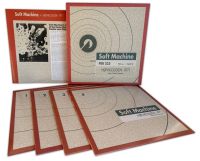 |
To anyone with even the vaguest interest in the avant-garde, jazz, psychedelia, counterculture and dare I say prog, Soft Machine need no introduction. With music that initially helped shape late 60s underground psychedelia, by the turn of the decade the band had adopted an almost purely instrumental prog avant-jazz aesthetic courtesy of what is generally considered to be their ‘classic’ line-up of founding members Mike Ratledge on keys and Robert Wyatt on drums, plus Elton Dean on sax and Hugh Hopper on bass. It is these four musicians who appear on Høvikodden 1971, showcasing Soft Machine at their virtuosic and improvisational best as they perform across two consecutive nights at the Henie-Onstad Art Center in Oslo. While the second gig was previously released back in 2009, for this latest release we are presented with a handsomely remastered version of what might at first glance appear to be two very similar shows – the tracklisting appearing near-identical – but rest assured this is most definitely not the case. Conceived in Canterbury in 1966, the original legendary Soft Machine lineup consisted of Wyatt and Ratledge, plus Australian-born Daevid Allen who, when denied readmission to the UK in 1967, went off to form Gong; and Kevin Ayers who departed in 1968 after the band had released their eponymously titled debut. Road manager Hugh Hopper promptly stepped in and replaced Ayers on bass while Elton Dean joined on sax. And once the swinging doors of ins and outs ceased, this version of Soft Machine managed to remain together long enough to create two of their greatest records, Third and Fourth, before Wyatt buggered off in 1971 to form Matching Mole. Before Wyatt’s departure, however, the band went on an extensive tour of Europe where on February 27th and 28th they performed at Henie-Onstad as part of the Lys Jazz-Pop Vinterfestivalen.
The performances were unique as they eschewed the standard gig-type venue, while light show pioneer Mark Boyle’s films projected as the band played. In fact, the gigs were put on by the Boyle family, Mark Boyle as part of Sensual Laboratory, with partner Joan Hills, was an old-time Soft Machine touring buddy thanks to their innovative light shows but by 1971, they only joined forces occasionally; this was to be one of those times.
In the Henie-Onstad crowd enjoying what the band had to offer was Hans Voigt – a Norwegian superfan converted when he heard Volume Two, resoundingly hooked when Third was released and absolutely integral to the eventual release of the gig recordings. “The concerts gave me almost all I wanted,” says Voigt in the liner notes. “I say ‘almost’ because they didn’t play ‘Moon in June’ and Robert no longer sang much at that point. Meeting the band before and after the concerts, I got the impression that although the performances were fantastic, the atmosphere within the band wasn’t the best.”
Given the fact that the band were on rocky ground, there is something even more special about these two recordings. As an avid collector and radio broadcaster in the 90s and 00s, Voigt found that many curios would get thrown his way, including a poorly-recorded version of the second-night performance at Henie-Onstad, which Voigt was aware had been recorded. “A colleague of mine at the Norske Teatret, where I worked as stage manager in the ’70s, was sound engineer Meny Bloch, and I actually remembered seeing him at the gigs with his tape machine connected to the mixing desk.” Once they recovered from the venue itself the recordings ended up being passed over to Michael King who released the performance on Reel Recordings calling it “demonstrably the finest recording of the classic Soft Machine quartet ever committed to tape.” A decent recording unquestionably, but for Høvikodden 1971 the new transfers from Norway's National Library combined with remastering have produced an unmatched and beautifully crisp reproduction that gives some insight into the experience of witnessing Soft Machine in 1971 when the band were arguably at their peak.
So, what about the music. The tracklists are near-identical (an additional encore of Third’s ‘Slightly All The Time’ on the 28th) but the two performances diverge with subtle (and not so subtle) shifts in nuance, emphasis, focus and style. Most of the set was taken from the aforementioned Third and Fourth albums, in fact both were played in their entirety with the exception of Third’s ‘Moon in June’. ‘Facelift’ is first up on the setlist but the contrast between the performance on the two nights is palpable – on the 27th it feels as if the band are finding their way; the second sounds far more accomplished, the band tighter and with more direction. ‘King of Queens’ is the same; Wyatt really stepping into his drum solo. As expected, ‘Virtually’, ‘Teeth’, ‘Slightly’ – all now-classic Soft Machine tracks sound wonderful – run through with virtuosic musicianship, freedom and pure enjoyment.
But the setlist wasn’t just restricted to Third and Fourth. Extra treats include ‘All White’ the only new track to be played featuring Ratledge and his Fender Rhodes Piano and which was to appear on their next record Fifth - Wyatt having left by this point. ‘Pigling Bland’ also appears on Fifth but was not a new one at the time – in fact it had been around for a couple of years originally intended as part of Volume Two’s ‘Esther’s Nose Job’. And then there’s ‘Neo-Caliban Grides’, released much later when their back catalogue became ripe for mining, but an outstanding avant-free jazz wig-out that acquires slightly more madness on the second night. ‘Eamonn Andrews’ appears too. A bit of a mystery of a track that pops up on sessions and in live performances and here it sits at the end of Wyatt’s vocal improvisation. All in all, Night Two maybe has the edge in terms of quality and excitement of performance - the band perhaps more in the swing of it, but both are truly fascinating and musically joyous. Høvikodden 1971 is a must.   Sarah Gregory Sarah Gregory
|







 (c) Musique Machine 2001 -2025. Twenty four years of true independence!! Mail Us at questions=at=musiquemachine=dot=com



