
Spirogyra - The Future Won’t Be Long, The Albums 1971-1973 [Esoteric Records/ Cherry Red - 2022]As a youngster, aged 9 years old Barbara Gaskin and Dave Stewart (of Hatfield and the North) had a number one hit single with the 1963 Lesley Gore classic “It’s My Party (and I’ll Cry If I Want To)”. The song wasn’t really my thing, however, it stuck with me throughout my lifetime, popping up from time to time as an earworm. During the 1990s, dissatisfied with the music of the time, I started to look backwards discovering a wealth of amazing music, initially in the psychedelic scene of the 1960s and subsequently the prog and folk rock of the 1970s. Bands like Caravan, Soft Machine and Hatfield and the North began to show up time and again and I developed a love of what I later discovered to be the music of the Canterbury scene. The deeper I became entrenched in this music, the more I started to hear the name, Spirogyra. Originally formed in Canterbury in 1970, the band fronted by the aforementioned Barbara Gaskin would go on to release three albums of superior whimsical English folk-rock without ever receiving the attention of several of their peers." />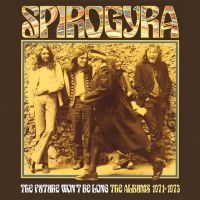 |
As a youngster, aged 9 years old Barbara Gaskin and Dave Stewart (of Hatfield and the North) had a number one hit single with the 1963 Lesley Gore classic “It’s My Party (and I’ll Cry If I Want To)”. The song wasn’t really my thing, however, it stuck with me throughout my lifetime, popping up from time to time as an earworm. During the 1990s, dissatisfied with the music of the time, I started to look backwards discovering a wealth of amazing music, initially in the psychedelic scene of the 1960s and subsequently the prog and folk rock of the 1970s. Bands like Caravan, Soft Machine and Hatfield and the North began to show up time and again and I developed a love of what I later discovered to be the music of the Canterbury scene. The deeper I became entrenched in this music, the more I started to hear the name, Spirogyra. Originally formed in Canterbury in 1970, the band fronted by the aforementioned Barbara Gaskin would go on to release three albums of superior whimsical English folk-rock without ever receiving the attention of several of their peers. The Future Won’t Be Long is a 3-disc box set that collects together the band’s entire discography, the three albums, St. Radigunds’ (1971), Old Boot Wine (1972) and Bells, Boots and Shambles (1973). On top of this, Old Boot Wine features bonus tracks recorded during that album’s recording sessions, whilst Bells, Boots and Shambles features I Hear You’re Going Somewhere (Joe Really), which was originally released as a standalone single in 1973.
Disc one features the band’s debut album St. Radigund’s. Sonically, it sits somewhere between The Incredible String Band’s gorgeous psychedelic approach to folk music and Comus’ much darker, disturbing musical entity. St. Radigunds’ draws you in from the first listen and won’t let go. Gaskin shares lead vocals with guitarist/ singer/ songwriter and founding member Martin Cockerham. The pair’s voices complement one another perfectly, and the album is stuffed to the gills with exquisite vocal harmonies. St. Radiguns remains one of the unsung gems of the 1970s for me, as good, if not better than anything that was being released by the likes of Fairport Convention or Steeleye Span at the same time. Favourite tracks include the album’s epic closer, "The Duke of Beaufoot", "Magical Mary" and opener, "The Future Won’t Be Long".
Disc two features the band’s sophomore release, Old Boot Wine, an album that owes a little more of its sound to Fairport Convention and Steeleye Span as well as the previously mentioned, Comus. Comus sprang up the previous year with their darkly unique debut album, First Utterance, an album that still sounds fresh and completely unique even now almost 50 years on. Old Boot Wine features even more of those gorgeous vocal harmonies that made Radigunds’ such a special record. Favourite tracks include the ISB inspired "Grandad", the super-trippy "World’s Eye" with its almost Jefferson Airplane- like vocal harmonies and the beautifully fragile “A Canterbury Tale”.
Disc three features the band’s final release, Bells, Boots and Shambles. What immediately strikes you is that this doesn’t sound like a band about to break up. It may even be their best work! The album has a really cohesive feel to it. The songs are achingly beautiful and the arrangement by Shirley Collins seem to help to add an extra layer to the band’s sound, however it didn’t sell very well and this would sadly, prove to be the band’s final album.
Overall, I think this is a wonderful career-defining collection by one of the great underappreciated bands of the 1970s. They may have left us a legacy of only three albums, but what a selection of albums they are! Whilst other bands of the Canterbury scene took all the plaudits, Spirogyra managed to plod on, under the radar making some of the finest music to be associated with the genre. At their best they are a match for any of the big hitters of the genre, it’s just a shame they never received the attention of a Caravan or a Soft Machine. The whole package is a thing of beauty and, it’s truly wonderful to see that these incredibly collectable albums have been reissued in such a lovingly put-together boxed set.   Darren Charles Darren Charles
|







 (c) Musique Machine 2001 -2025. Twenty four years of true independence!! Mail Us at questions=at=musiquemachine=dot=com



