
Keiji Haino & Guro Moe - Drums & Octobass [Conradsound - 2024]" />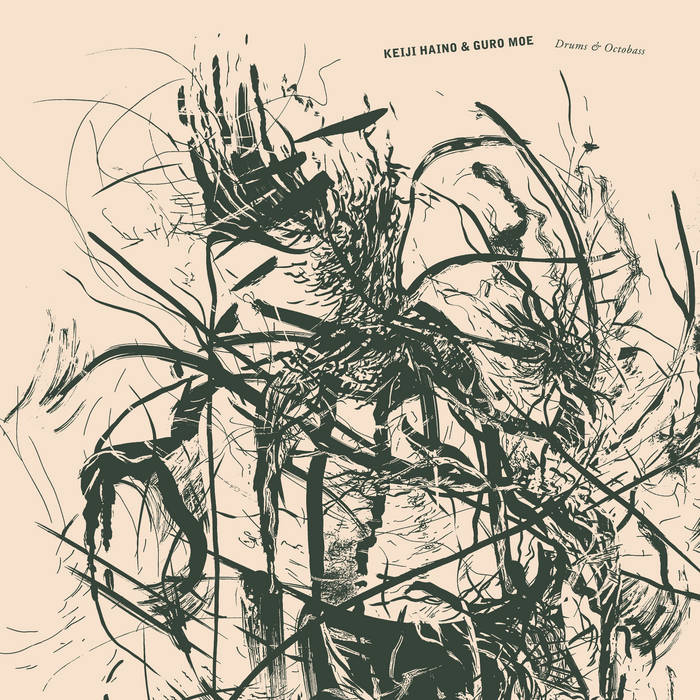 |
Keiji Haino (from Japan) and Guro Moe (Norway) are a pair of veteran experimental artists, here playing a kind of richly textural free improvisation with novel instrumental timbres and playing techniques. This new collaborative recording, "Drums & Octobass" was released on Guro Moe's label, Conradsound. It has three tracks, the first two being roughly eight minutes, and the final one much longer at fourteen minutes. Sounds of wooden tapping, rattling and semi-tonal bowed scraping emerge, presumably from the 'octobass', as these sounds all bear the signature characteristics of a large, low register stringed instrument, although the instrument is not being played in traditional fashion.
Joining this shuffling cacophony are high-register melodic lines, a tone somewhere between an organ and an accordion (as it turns out, it is a harmonium). We hear also the wailing and moaning wordless voices of both musicians, spontaneously erupting wherever appropriate, and at times waxing melodic, joining in tuneful unison with the harmonium.
Though it is often chaotic in a free jazz manner, particularly at the beginning of the recording, much of the album has a great deal more space, and a more meditative effect. For many minutes in the middle of the second piece, "flower which is pink, small and resistant", we listen to the gradual dissipation of occasional cymbal crashes over a faint subsonic rumbling and softly intoned vocal drones.
The resonant qualities of the unusual chosen instruments and eerily dissonant quality of many of the note choices create a heavy mystic strangeness in combination with the focused minimalism of the playing. I could compare it to John Zorn's occult-themed "IAO" and other releases on his Tzadik label, or perhaps to classical minimalists like La Monte Young or Morton Feldman.
The last piece is dominated by cadences from cymbals and a snare drum, in a strange dissociated interplay with a falsetto voice. Though much longer than the first 2 pieces, it is also more desolate and sparse, with understated rhythms of variable speed carrying on unaccompanied for many minutes in a row. It's more difficult to stay engaged with this piece than before, but I enjoy the variety of percussion found here, particularly some of the metallic sounds found near the end that I can't easily identify.
All in all, an interesting recording with clever instrumental choices and timbral interplays, though the creative process is certainly unstructured, and there are a few moments when momentum lags. Though it is comprised entirely of untreated acoustic recordings, it has the kind of esoteric, otherworldly feeling one might associate with electronic avant-garde or musique concrete. Drop by here to find out more    Josh Landry Josh Landry
|







 (c) Musique Machine 2001 -2025. Twenty four years of true independence!! Mail Us at questions=at=musiquemachine=dot=com



