
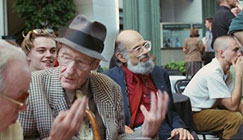
William S.Burroughs in the Dreamachine — Directed by Aes-Nihil and Dr David Woodard
The film's opening fifteen minutes revolves around downtime at the LACMA and features such revelatory scenes as Burroughs drinking wine, Burroughs signing some books, and even Burroughs holding someone's baby. All this set to suitably addled tribal drumming and flutes sounding vaguely like Yemeni tibbal trance music. It would be nice to know the name of the musicians or group involved but alas the credit is absent. The stand-out moment from these scenes as the opening credits to the DVD and the notes on the sleeve indicate is a cameo from Hollywood A-lister and perpetual ugly stick pugilist Leonardo DiCaprio who appears in all his youthful floppy haired glory in a strange sequence with Allen Ginsberg where neither seems able to operate their cameras. Half was through the LACMA footage we go to the Nova Convention and hear Burroughs reading while the camera focuses in on some of his paintings. It's unclear whether the sound and images are from the same event.
The bulk of the film is taken up with footage of Burroughs at his home in Kansas divided into three parts between which Woodard performs two skits, riffing vaguely on the subjects of the Dreamachine and the Cut-up Method. The former, which at one point shows Woodard dressed in a suit, manufacturing a Dreamachine in what looks like his living room, provides the film's only moment of genuine humour as he very nearly catches his tie in the blades of a Jigsaw he is using. Otherwise, the two segments seem more like half hearted attempt at Burroughsian style prose read into a student film about route 666. The production values and editing here however are a class apart from the sub-home movie quality of the footage with Burroughs in his home. The sound is in fact so bad that one can barely make out the conversation which dwells for the most part not on the Dreamachine but rather on contemporary issues of the War or Drugs and different countries attitudes to drug law.
When the conversation does wander we learn Burroughs thinks Ron L Hubbard was utterly corrupt, but smart and there is an odd segment where Woodard, who leads the discussion, talks at Burroughs about a maverick attorney who defended Jack Ruby and who had a reputation for bringing in body parts to the court room to shock the jury. Burroughs seems absent. Indeed confronted with the discourse of Woodard, which is without direction (it's not an interview) and displays the nervous glossolalia of a fan desperately trying to hold his idol's attention, Burroughs appears visibly wary, even bored. There is quite simply nothing of content in their exchange aside from vaguely conspiratorial ramblings emanating from Woodard and some responses on contemporary issues from Burroughs. Anyone looking for even the smallest morsel of insight into Burroughs history with the Dreamachine or his use of the thing for creativity will be sorely disappointed. The flickering light of the machine is ever present on a table during the discussion, but that is as far as it goes.
The film plays out to a minute or so of Burroughs reading at the Nova Convention in February 1997 before he takes his final bow and walks off stage. The clip is courteously of Kenneth Anger who must have taken a plunge into his second childhood to have agreed to get involved with this project (he even offers a blurb on the reverse of the DVD sleeve). I genuinely cannot find anything to recommend this film aside from it containing the last images of Burroughs before his death. But even that is totally undermined by the almost disrespectful way that Burroughs is filmed. A lifetime of literary and personal adventure and counter-cultural light is reduced to a home movie talking about drug laws in Switzerland. Even the most fanatical Burroughs completist will want to hold their nose at this one.