
White Sun of the Desert — White Sun of the Desert( DVD)
White Sun of the Desert is a Russian action/adventure film from 1970 directed by Vladimir Motyl (Gone with the Horses, Zvezda Plenitelnogo Schastya and Rasstanemsya – Poka Khoroshie). The film stars Anatoliy Kuznetsov (Vstrechi Na Rassvete and Polosa Vezeniya), Pavel Luspekayev (Isini Chamovidnen Mtidan, Mertvye Dushi and Ori Okeanis Saidumloeba), Spartak Mishulin (Master I Margarita, Verbovshchik and Dostoyanie Respubliki) and Kakhi Kavsadze (Midjachvuli, Tsar Ivan Groznyy and Tskhovreba Don Kikhotisa da Sancho Panchosi).
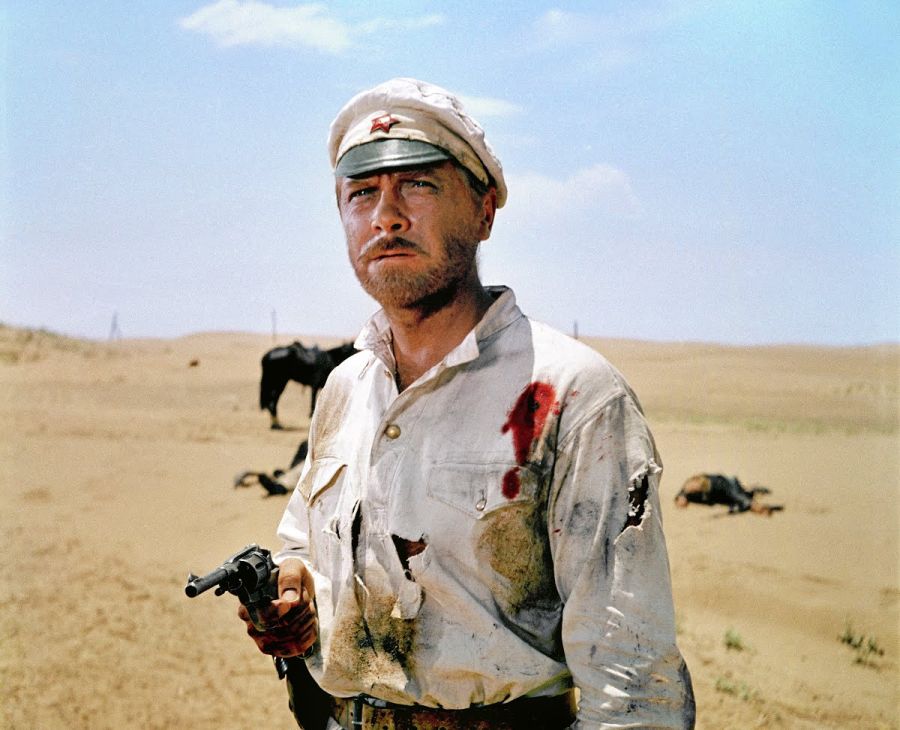
Inspired by American westerns like Stagecoach and High Noon and spaghetti westerns like Sergio Leone’s Man with no name trilogy or Django, White Sun of the Desert is set during the Russian Civil War and follows Fyodor (Kuznetsov), a red army soldier who has been fighting near the Caspian Sea and is trying to get home. The opening shot shows his wife, Katerina Matveyevna (Galina Luchai in her only ever role), walking through a meadow. Alas, this is a daydream, cue cutting to the real scenario he finds himself in, he is tramping through the Central Asian Desert where he finds a man, Sayid (Mishulin) buried up to his neck in the sand. Fyodor frees the man, and the pair begin travelling together. The pair get caught up in a fight between Red Army soldiers and Basmachi guerrillas. The Commander of the Red Army cavalry heads off in pursuit of the guerrillas, who are led by a man named Abdullah, but leaves Fyodor and one of his troops, Petrukha (Nikolai Godovikov) behind to protect Abdullah’s harem. Fyodor hopes to set the women free and see them become modern women, however, they take to him and declare him their new husband. Before long, Abdullah and his men arrive at the same village as Fyodor and the harem. Fyodor and the women must find a way to evade the clutches of a very angry Abdullah, who intends to murder them all.
White Sun of the Desert is a beautifully shot movie, most of which was filmed near the western shore of the Caspian Sea, the Karakum Desert near Mary, Turkmenistan, and around Makhachkala, Dagestan and the city of Merv. The performances are excellent across the board and the film itself is well structured and beautifully written. It is fairly short at only 83 minutes long, but it certainly doesn’t feel rushed; it feels like it is the appropriate length. The film has a surprisingly feminist stance, as Fyodor tries to persuade the women of the harem to become more independent, telling them that the revolution has set them free.
The restoration of the movie undertaken by Mosfilms is quite astonishing; it looks beautiful, far better than any Russian film of its age deserves to be. The print is crisp and clean with no noticeable print damage anywhere and very natural colours throughout. The disc from Deaf Crocodile features some good bonus materials, including an interview with Russian Red Westerns author Sergey Lavrentyev, a commentary track featuring Rolf Giesen, a visual essay by Evan Chester and a new restoration trailer.
Overall, this is a beautiful package for a vastly underappreciated movie. One that has never reached Western shores until now. As westerns go, this one is a cracker, just set in Russia during the Civil War instead of the late 18th-century US. The movie itself is beautifully crafted and deserves to be seen by fans of not just Russian cinema but fans of westerns too.