
The Last House On The Left — The Last House On The Left( Blu Ray)
From the early 1970s, The Last House On The Left stands as possibly one of the most influential and problematic grindhouse/ cult films of all time. It was also the first major work of two figures who would become key horror directors in years to come- directed by Wes Craven (Nightmare on Elm Street, Scream), and produced by Sean S. Cunningham (the first Friday the 13th). The film tells of two teen girls who are picked up, abused, raped, and tortured by a band of escaped criminals, and the ensuing revenge carried out by one of their parents. Here from 88 Films is a recent Blu-ray release of the film- taking two cuts of the picture- two new commentary tracks, two new documentaries- one on the rape-revenge genre the film spawned, and one on Wes Craven. As well as a selection of other new and archival extras.
The Last House On The Left was made in the year 1972- been shot between the wooded countryside of Connecticut and New York City's rundown suburbs. Craven directed/ co-wrote the film, with it being inspired by Ulla Isaksson 1960 novel The Virgin Spring. It was Craven's first film, and he, of course, became one of the world's best-known/ important horror directors, releasing the likes of The Hills Have Eyes (1977), A Nightmare On Elm Street (1984), and Scream 1, 2, and 4.
The fully uncut version of the film runs at one hour and twenty-four minutes, and begins in a fairly cozy/ safe/ light manner as we see banter between just-turned-sixteen Mari Collingwood (Sandra Peabody), and her middle-aged parents- John (Richard Towers), who's a tickly side-burned doctor, and her housewife mother, Estelle (Cynthia Carr). Mari is off to a rock concert with her friend from the nearby city, Phyllis (Lucy Grantham), who is a similar age, but maybe a little more streetwise.
As the first five or ten minutes of the film unfold, we see the pair in the autumnal woodland that surrounds the Collingwood house- as bright, mellow, tuneful male-fronted folk-rock plays- the score is courtesy of the film's lead criminal, David Hess- who, when we meet him later, is anything but light ‘n’ bright.
Anyway, the teens head off to a gig, stopping first at the city; we then switch to a city set squat/ apartment where our criminal gang are hanging out. It consists of the heavy-set and dark curly-haired Krug Stilo (Hess) and skinny bouffant haired/ suit and sandal wearing Fred 'Weasel' Podowski (Fred J. Lincoln)- we find out via a news report that they’ve just escaped from being imprisoned for rape and murder, and on the way out they killed a police dog. They are joined by Kurg’s illegitimate / jean jacket-wearing son Junior (Marc Sheffler) whose Krug has got hooked on heroin. And ragged-haired/ wild woman Sadie (Jeramie Rain).
Junior encounters the girls- convinces them he has drugs, and bang, they're in the gang's trap- they are taunted, then attacked off-screen. But the next day their bungled up into a car. But fairly soon it’s breakdown in the countryside, not far from the Collingwood home.
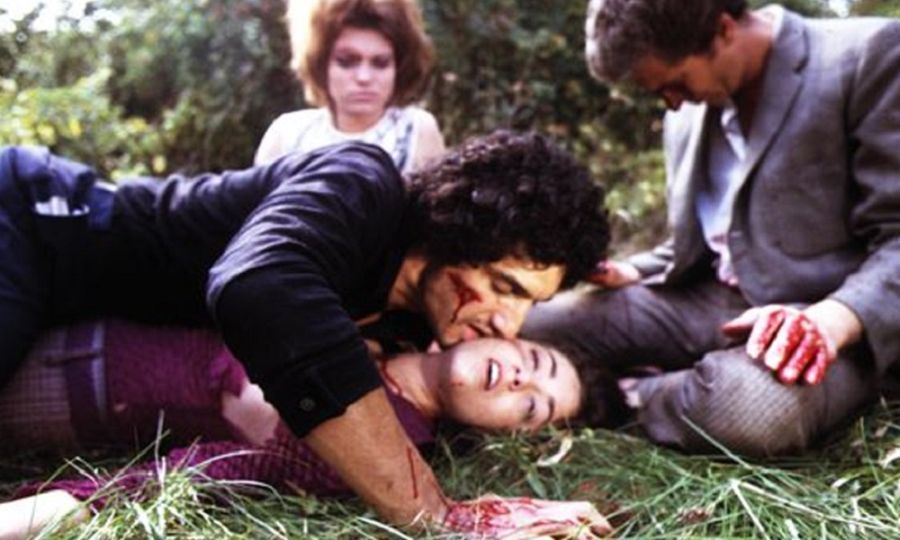
The two girls are first taunted and degraded- before being attacked/ raped; before the uncut version, I’d only seen the R cut-and boy, the attack scenes are so much more intense/ gory/ troubling… with stabbed-up guts, and a severed arm.
Woven between the attacks, we move from the Collingwood house- where Mari’s parents are getting more and more worried- and footage of the rather comedic pair of cops that are meant to be investigating the missing girls. Before the parents get their revenge.
It must be, say, fifteen years since I’d last seen The Last House On The Left, and in the key troubling scenes it remains deeply troubling. I recall the first time I saw the film years back, and I always remember thinking the comedic/ light scenes where ill-fitting/ tonally unbalancing- but now, revisiting it, I think they work perfectly, as they make the troubling stuff even more skewed/ upsetting.
This Region B Blu-ray features two versions of the film: ' Unrated’ [84 mins] and the ‘R-rated’ [82 mins]. Both are HD scans, and they truly enhance the film's colouring- going from the yellows & oranges of the autumnal woodland to the buoyant colouring of some of the clothing, and the troubling shades of red blood.
Moving on to the extras, we get a great selection of new things. First of all, we have two new commentary tracks- one with genre experts Eugenio Ercolani and Troy Howarth, and one from horror/ cult podcasters The Nasty Pasty. I played the first of these, and this is, as expected from these two pros, a very well informed/ researched affair. They begin by talking about how, from the off, you can see that Caven is a director who had great ideas, a keen sense of social issues, with a political backbone. They discuss how the teen characters feel at home in nature. We find out the script was penned in August of 1971, going onto filmed in October of the same year. They talk about how Craven wanted to make a film to provoke the audience, as well as commenting on the desensitising of violence due to Vietnam War footage being shown on the TV news. They discuss the naïve parents in the film, which later became somewhat of a trope in rape/ revenge films. They talk about the contrasting father figures in the picture. And debate whether or not the film can be considered a horror film. We find out that initially it was going to be a hardcore porn film, and they touch on how the film still has moments of icky stickiness. They talk about how the original script had moments of both necrophilia and cannibalism, and that Caven filmed some of these scenes. Later on, they touch on the dark comedy of the characters. We find out that the Collingwood house was in reality the family home of Sean S. Cunningham. They discuss how some of the shot composition is rather sloppy in the latter part of the picture, and of course much more. It's well worth a play-through
Next, we get two feature-length documentaries- exclusive to this release. First is Betrayal and Retribution - The Spawn of the Last House on the Left ( one hour, thirty minutes, fifty seconds). This was the doc I was most looking forward to when I read up on the new stuff on this release, and I’ll have to say I was rather let down/ underwhelmed. Firstly, it only covers Italian films of the 70’s/ 80’s, aside from a very brief mention of Abel Ferrara’s Ms .45- so in no way is it a definitive history of the rape-revenge genre. Secondly, for the first ten minutes or so of the doc, we have a very academic/ rather dry/ frankly boring talk from an Italian historian, where he discusses how sex/ sexual imagery was treated in Italy through the ages- it's very hard going, and at points I generally thought I was watching a different doc. Anyway, it takes until the seventeen-minute mark to formally talk about the films themselves, with the first being The Children of Violent Rome (1976). As we go on, we have interviews with the likes of director Ruggero Deodato- The House on the Edge of the Park (1980), actress Macha Méril regarding Night Train Murders (1975), and a few other directors/ actor connected with the Italian genre. Mixed in with these, we have input from genre experts like Eugenio Ercolani (who's behind the film), and a few others. Some of the interviews are worthwhile, but I can’t say I learnt much more than I knew already; also, the whole structure of the doc seems to largely drift about- not settling long enough on one particular picture. So, all in all- rather disappointing documentary.
The second documentary is Remembering Wes Craven: His Life, Legacy and Nightmares (one hour forty-seven minutes & thirty seconds). The film is a blend of talking heads and footage from Craven’s films- be they from the picture or behind the scenes. The documentary doesn’t cover the whole of his career but a fair chunk. We open with a few minutes of montage of talking heads- touching on how kind, quiet, and approachable he was. Next, we get an interview with Michael Berryman- he moves from talking about how he got the role in the first Hills Have Eyes, his character in said film, what Wes was like on set, and the one/ only scene they disagreed about. Hills Have Eyes Part 2 is briefly mentioned. Next, we have Adrienne Barbeau discussing her role in Swamp Thing- she talks about how she never heard Wes raise his voice on set and how he was a very gentle director, even though all the issues the film had during filming and production. Next, we move on to Heather Langenkamp, who goes from talking about when she went for an audition on the first Nightmare on Elm Street- which she thought was going to be a Brat Pack-like film with a dream monster- to talking about working on the film with Wes. She moves on to talking about Elm Street 3, and Wes Craven's New Nightmare- the latter in more detail, touching on how it impacted her personal life, and the disappointment of the box office. Next, and really for the rest of the documentary we get an interview Patrick Lussier- who worked as an editor on a fair few Craven films, and was good friend of him- this section covers- Vampire in Brooklyn, Scream 1, 2 & 3, Music Of The Heart, Cursed, and Red Eye- plus Dracula 2000- which Lussier directed, but Caven was a very hands on with/ an executive producer. This was a really interesting documentary, with a lot of stories I’d never heard before, and it’s lovely to see that everyone who encountered Mr Caven was such a nice person.
Lastly, on the new front, we have Endangered Teens (23.09) a video essay from Heather Wixson, who writes for horror site Daily Dead.
On the archive side, we get a ton of things. Audio commentary with David Hess, Marc Sheffler and Fred Lincoln [Unrated Cut]. Audio commentary with David Hess, Marc Sheffler and Fred Lincoln [Unrated Cut]. Celluloid Crime of the Century – featurette. Scoring Last House - featurette with David Hess. Tales That Will Tear Your Heart Out - unfinished short directed by Wes Craven and starring David Hess.. Outtakes and dailies [47mins]. Deleted Scene - “Mari Dying at the Lake”. Wes Craven Introduction. Still Standing: The Legacy of “Last House on the Left”. Making of Last House on the Left (29 mins). Forbidden Footage. Trailer, and Image Gallery. Truly is astonishing how many extras they have managed to cram onto a single Blu-ray disc.
One could most certainly say that The Last House On The Left stands as one of the most influential/ infamous exploitation films of all time. So, it certainly is wonderful to see 88 Films giving us this new release. Featuring a wonderful new scan and a brimming selection of extras- both new & old. Even if you already own the film in another format, it’s well worth the upgrade due to the scan and the hours of new extras.