
The Good Boy — The Good Boy( VOD)
Polish director Jan Komasa’s first English-language film, The Good Boy (2025), also known as Heel, is a darkly comic thriller with an eye on society. The opening scenes, when we’re invited out on a night out with Tommy (Anson Boon), leave us in no doubt that he’s a delinquent and an anti-social problem—the question is, can and should something be done about him?
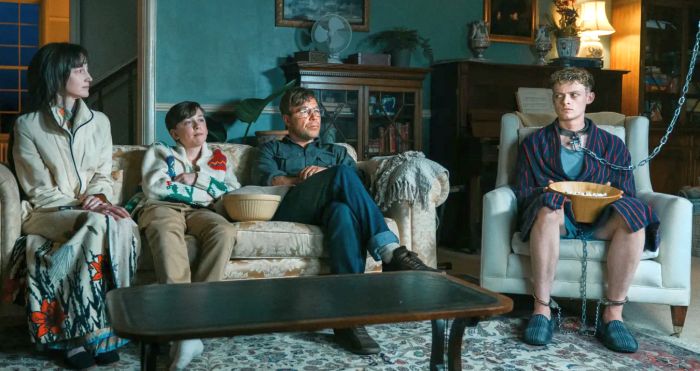
Tommy wakes up from a drug, violence and booze-filled night, manacled in the basement of a large family home. Only the family above is an odd bunch, with a distinct sense of secrets bubbling beneath the surface. Upstairs, an uptight father (Stephen Graham), a nervous mother (Andrea Riseborough) and a son (Kit Rakusen) who could come from the 1950s all act their version of ‘normal’. Downstairs, Tommy is subjected to a carrot-and-stick campaign to make him change his ways.
It’s sometimes hard to tell what The Good Boy is. A statement on the nuclear family? A dark and obtuse comedy? A fictionalised social experiment? The answer really sits between all three—and it’s clearly a space where Komasa relishes the chance to reference, satirise and challenge.
In some ways, The Good Boy runs like a wry gothic melodrama—complete with the vast, mysterious house at the end of the driveway—but Komasa and writers Bartek Bartosi and Naqqash Khalid can’t resist having Tommy and one of his captors bond over their dislike of Jane Austen (who penned something very similar herself with Northanger Abbey). That’s indicative of what the filmmakers cook up here: a film that relishes drawing us into a concept that stretches credibility but won’t let us sit comfortably—it’s intent on keeping us on our toes by prodding and testing it. The Good Boy could be difficult to watch, then, but particularly thanks to a very strong cast, it’s a satisfying watch.
Tour-de-force performances roll through the darkly comic tale. Uptight, aspirational and prone to disappointment, Graham’s softly spoken Chris is typically watchable under a toupee. Opposite him, Riseborough’s nervy, agoraphobic and ghostly pale matriarch Kathryn is a twisting study in nervousness and steely resolve. The dynamic between the pair as they enact their behavioural-change regimen on Tommy is fascinating. It’s hard not to warm to them just a little. Then there’s Tommy. Boon continues his ascent with a standout role, selling a character who has to be difficult to like but, as a captive, is impossible not to root for. The nuances at work in these characters are a sign of the impressive balancing act Komasa pulls off.
The Good Boy’s success is packed with small touches and little idiosyncrasies that show that the director is having fun with this high-concept canvas and the top-drawer talent moving around it. It’s packed with points of tension all the way through: the uptight dad who might as easily snap in two as explode; The captive who might escape; the housekeeper who might blow everything wide open. When these moments pay off, they don’t run as expected—Komasa clearly wants to keep the viewers’ synapses sparking and fizzing.
You might think at the start of The Good Boy that there’s little chance things can turn out well, but up to the end, Komasa has some surprises. A particular surprise, after the quirks and wry spin of its 110 minutes of creeping domestic horror, is The Good Boy’s downbeat ending. The journey, though, is all about riveting filmmaking with a lot to say about society, our neighbours and ourselves.