
The Cars That Ate Paris/ The Plumber — The Cars That Ate Paris/ The Plumber ( Blu Ray)
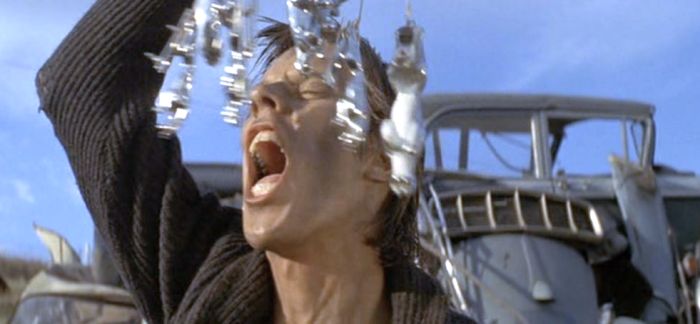
The Cars That Ate Paris is a decidedly woozy & uneasy blend of black-as-your-hat comedy, grimly quirky drama, consumerism satire and low-key horror. The early 1970’s Australian film regards a small town, where the citizens are deliberately causing car crashes, and the rather meek & mild man who gets stuck in said town. It’s a film that is very hard to pin down into one genre, but there's often a keen sense of both menace and low-key absurdity. Here from the BFI is a two-disc Blu-ray release of the film, taking in a 4k scan, new commentary track, and a mix of new/ archive extras. Also included is The Plumber, a made-for-TV thriller by the same director, with its own extras. This release is also available as a UHD variant.
The Cars That Ate Paris appeared in the year 1974, and it was the first feature film from Sydney-born writer/ director Peter Weir, who is probably most known for the period drama/ dreamy mystery that is Picnic At Hanging Rock (1975). Between the late ’60s and early 2010’s, he has thirteen feature credits to his name- these go from supernatural thriller The Last Wave (1977), WW1 adventure drama Gallipoli (1981), and social satire-come-comedy drama The Truman Show (1998).
The film kicks off in full consumerism satire form as we see a giggling & handsome couple jumping into a convertible on a summer's day. They are posing, holding cigarette boxes, drinking colas, etc. They come around a corner onto a mountainside road- to suddenly leave it, and tumble down the rocky side.
We then meet our lead, the meek, mild, and balding Arthur Waldo (Terry Camilleri)- he’s in a car with his brother, and they are towing a caravan. As dusk is coming in, they too head onto the mountain road- and just as they turn the corner, bright lights flash at them, finding them careening off the road.
Next thing we know, Arthur is awaking in the hospital in the small town of Paris, which nestles below the mountain. Here, he meets a selection of rather odd characters- first of these is The Doctor (Kevin Miles), who talks about wanting to ‘experiment’ on him, and shows him pictures of bloody car crashes.
When he’s up and about, he meets the town's mayor- played by Oz acting legend John Meillon (Walkabout, Crocodile Dundee). He shifts between awkwardly charming, manipulative, and coolly controlling. Also in the town, we have the jackbooted and leather-hatted sheriff (Danny Adcock) who is always keen to cover up crashes. Controlling/ lightly sinister bureaucrat Metcalfe (Max Gillies). There’s the wild-eyed and unpredictable Charlie (Bruce Spence), who has an eye for car emblems, and a few others.
The hospital is full of largely brain-damaged people from the crashes. The town's dusty main street flows with careening stock cars, and at night, there’s a mix of odd screams, and guttural grunts in the air.
Arthur is most keen to escape Paris, but it’s made clear that the mayor won't allow this. And the deeper we get into the film, the more we become aware of the town's devious, at times, murderous ways. At one point, we see a disoriented and bloody man being dragged into be strapped to a table- his possessions stripped off him & bagged, and his car is burnt.
As I mentioned at the start of this review, there is a decidedly woozy quality about the film, and along the way, there are some great moments of chilling disquiet, sudden jarring terror, and cool/ calculated unhinged-ness. The film features an effective score that moves between twanging harp-like soap opera brightness to brooding & uneasy bass tone dwelling.
Camilleri is perfect as our nervous, glum and rather jittery lead, and you do generally feel for him. Meillon is great as the town's master controller. And the support cast is well picked, too.
I recall seeing the VHS case for The Cars That Ate Paris back in the 80’s and was always curious. Though I never saw it, as I thought it sounded like some odd French comedy. So, it’s great to finally see it, and I must say it has a fairly distinctive/unequal quality.
Extras-wise, on this first disc, we get a nice selection of things. On the new side, we have a few things- first off is a commentary track by Australian film expert/ author Dr Stephen Morgan- I’ve played a few of his featurettes/ visual essays in the past, but this is the first track I’ve heard from him, and he does a great, informative & interesting job. He talks about how he himself grew up in a small town in Oz and can see grains of truth in the film. He talks about how the film was shot during the oil crisis of 1973 and how the film remains relevant. He touches on how the film went on to influence other pictures, like the original Mad Max film. He points out actors as they appear, giving brief bios. We find out Weir was inspired to write the story/script from several issues/ encounters he & his wife had on a road trip to Europe & the UK. He talks about the film's location, which is a town in the plains of New South Wales. He points out great set design items in the background of some of the shots. He quotes from an interview with the film's producer at the time of the film's release, saying their focus was on making a universal, not an Australian film. Later on, he talks about he talks how/ when the genres start to fracture. Touches on the spiked cars, and much more. All in all, an excellent track.
Otherwise, on the new side, we have the following. My First Film: Terry Camilleri on The Cars That Ate Paris (20.59): interview with the film's male lead. ‘Nobody Leaves Paris! No One!’ (14.47): a video essay by Chris O’Neill.
On the archive side, we have: 3 To Go: Michael (31.01) from 1970. Three young filmmakers, of whom Peter Weir was one, were commissioned by the Australian Commonwealth Film Unit to each write and direct a half-hour fiction drama on the theme of ‘Youth’. These were combined for cinema release as 3 To Go: Michael was Weir’s contribution to the project. Incredible Floridas (12.29) from 1972- a portrait of Australian composer Richard Meale. The Guardian Interview (1 hour & 10 minutes) a 1985 audio only Peter Weir. Interview with Hal McElroy (6.42): a 2008 interview with one of the producers of the film. Interview with Peter Weir – The Cars That Ate Paris (11.00) from 2008
On the second disc, we have The Plumber from 1979. This is a seventy-seven-minute TV movie, regarding a manipulative and unhinged plumber creating a living hell for a twenty-something couple. It’s a film that starts building its tension from the off- with some fairly surprising twists and turns along its length.
The film's credits open with a blend of taut, sustained drone and images of lines of pipes & glowing bolier. We then drop into the lives of the Cowpers- Jil (Judy Morris) and Brian (Robert Coleby)- she is a rather timid blond-haired woman who is working on her master's, and he is a bearded/slightly thinning-haired professor who teaches in the uni. They live in an apartment owned by the university.
He heads off to work, while she’s sitting in her shirt sleeves- there’s a knock at the door, and his the ragged curly-headed Max (Ivan Kants). He says he’s there to check the pipes, but as things unfold, there is clearly something amiss- as he makes a few random holes in the wall & takes a shower.
As the days passed, he claims he was in prison for rape, then denies it. He puts up a network of pipes so no one can get into the bathroom. As well as various mind games, and just coming short of physically touching Jill.
The thing that makes it worse is that no one seems to believe her- Brian is too wrapped up in getting a promotion, and her well-to-do yoga trainer neighbour, Meg (Candy Raymond) thinks she is making a fuss about nothing.
Both Morris and Kants are great as our leads- he becomes even more in bolded/ unhinged, and she more beaten down/ hunched by his behaviour. Along with being a worthy thriller, the film also makes some nice swipes at the class system, women's fear of men, and trying to grin and bear it. The Plumber is not only a great TV film, but a great film in general, and it’s wonderful to see it released here, so it can be judged with the rest of Mr Weir's filmography.
Extra wise on this disc, we have two new extras- first is a commentary track with academics/authors Alexandra Heller-Nicholas and Josh Nelson. They start off talking about how Weir made the film for the money- he wrote the story it was based on, and it was shot in just three weeks. They discuss how the film is all about tensions with class and gender. They touch on how it would have made a great play. They talk about where the film sits in the director's filmography. We find out the idea came about after Weir went to a party, where he was told by one of the guests about a plumber who just wouldn’t leave. They talk about the film's development and how Weir wasn’t going to direct it initially. The tracks fine, I guess, but at points does rather drift into coming across like you're sitting in on a lesson about the film, with a decidedly academic feel, and I’m afraid during these points my attention did start to drift. And there’s Peter Weir’s Dream Within a Dream (18 .26) sparked by the discovery of rare outtakes from Picnic at Hanging Rock, this newly made work by Polish filmmaker Jakub Duszynski offers fresh insight into Weir’s 1975 masterpiece.
On the archive side, an interview with Peter Weir – The Plumber (7.42) from 2008. Trailers and Image galleries.
The finished release comes with an illustrated booklet featuring a new written interview with Peter Weir, an original review, essays on The Cars That Ate Paris by Dr Stephen Morgan and on The Plumber by Tara Judah and writing about his short films by Peter Weir.
In conclusion, this is a great double film release- The Cars That Ate Paris is a wonderful, woozy mix of dark comedy, grimly quirky drama, consumerism satire and low-key horror. And The Plumber is a great tension-building thriller, which is really head and shoulders above your run-of-the-mill TV films. Each picture gets a lovely 4k scan- with a great selection of extras. Another stellar release from the BFI.