
The Boxer — The Boxer (Blu Ray)
Shuji Terayama’s The Boxer treads some familiar lines as a tale of sporting endurance and personal redemption, but the director’s experimental impulse and counterculture tendencies couldn’t resist adding some fascinatingly experimental moments to what appears to be, on the face of it, one of his more conventional films.
It is not a coincidence that The Boxer came out within a year of Rocky (1976). 1977, as an informative feature from Japanese cinema expert Tom Mes explains, was a pivotal year for Toei, the major Japanese studio that bankrolled The Boxer. As Toei tried to maintain the success they’d earned on the back of exploitation cinema in the first half of the decade, they increasingly turned to films that reworked recent American hits, like The Godfather (1972) and Jaws (1975).
The Boxer wasn’t as financially successful as Rocky, but in a way, it both influenced that film and foreshadowed the course the American franchise would later take.
As the only film Terayama made for a major studio, it’s not representative of those experimental and countercultural peaks of his career. But sitting in the middle of his run of nine features, it’s a fascinating and counterintuitive film well worth rediscovering.
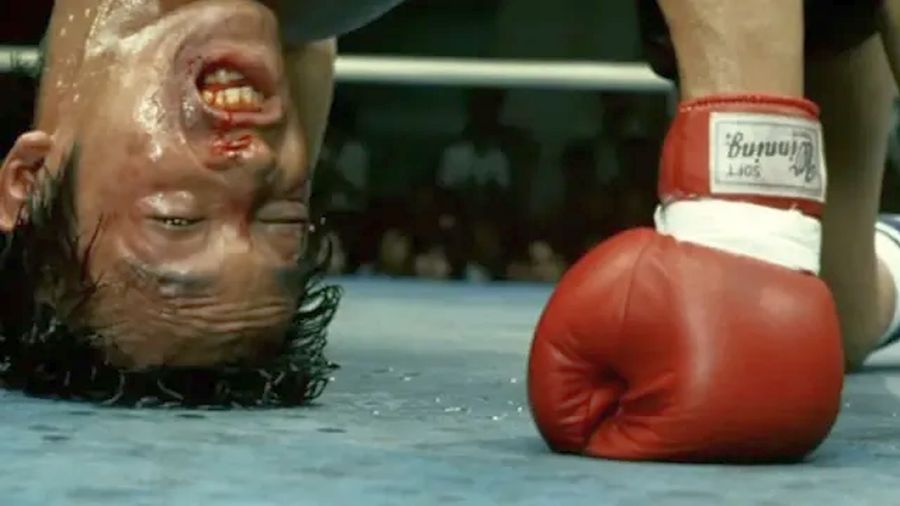
At the centre of The Boxer is the emphasis that, unlike Rocky, keeps the focus shared between the ageing boxing champ turned trainer (Bunta Sugawara) and his young, lame protegee (Kentaro Shimizu), a fighter who nobody thinks will get anywhere. Terayama was encouraged to write and direct the film at Sugawara’s suggestion and the result is fascinating. Both actors deliver impressive performances. Sugawara is boiling rage for much of the first half of the film—as a tragic accident pushes the two characters apart before they come together. Shimizu strikes a haunted figure, often left hanging in frame, his face, whether bloodied and beaten or not, silently emoting his torment at being written off again and again. On occasion, the emotional score matches this to what sounds like a proto 8-bit melody.
In one extraordinary scene, Sugawara’s old boxer recounts the inauspicious deaths that befell boxing champions when asked (by both his daughter in the past and protogee in the present) why he quit halfway through a fight. Experimental flashes like this mark The Boxer out as Terayama’s work—never more than in the sporadic cuts to a cafe bar. Those flashes, which happen throughout the film, serve up moments of absurdity (a chaotic chase for a chicken—”Fried chicken on the loose.”), cutaway philosophical musings on the brutality of boxing, or the scene of the young boxer’s breakdown. It’s impressive away from the cut and punch of the sparring scenes, and Terayama seems comfortable with both.
When Sugawara’s seasoned trainer relents, there’s an extended montage as audiences might expect, as the young boxer is brutally put through his paces. But by Rocky standards, this is a hugely extended montage, backed by a fashion of jazz and folk.Despite that influence and inevitable links, the narrative that sees the young fighter with a damaged foot compete for Rookie of the Year doesn’t slavishly follow the story or ending of John G. Avildsen and Sylvester Stallone’s 1976 sports film.
In and out of the ring, there is a grittiness hanging over the proceedings, a hallmark of the studio, but Terayama keeps things mixed up—this is equal parts grit and a colourful, banner- and dance-filled fiesta. The new HD transfer picks out both in brilliant clarity.
Elsewhere on this new Radiance release is the chance to dive into the travails of the studio as much as the film. The aforementioned video essay by Mes sets the tone of the era, and it’s fascinating to see Toei’s chase for genre boil down to aping American successes as its exploitation brand waned. Meanwhile, a recent interview with composer J.A. Seazer takes us behind the scenes of the fascinating soundtrack. The limited edition also comes with a booklet, and includes new writing by Maria Roberta Novielli.
The Boxer is a fascinating and punchy film, well worth a look for anyone more familiar with the western view of the sport.