
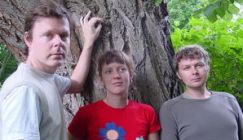
September Collective — Always Breathing Monster
For anyone who expects this album itself to be some sort of over-the-top, In-A-Gadda-Da-Vida monstrosity, rest assured; all too traditional organ blasts and pipe wankery are eschewed in favour of a much more subdued (and, if you wish, organic – let’s just get that pun over with) sound. First impression and initial, intuitive ruminations aside, further online investigation into the album reveals a bit more about the machinations behind it. Although Always Breathing Monster was indeed produced – primarily – on organ, the instrument was not used in any traditional sort of way. Pre-arranged MIDI-files were fed into the organ, and for a couple of hours, the trio of September Collective recorded numerous improvisations on the organ and a piano with microphones placed in different parts of the church where all this was recorded, the Johannes Kirche in Düsseldorf. These improvisations were ultimately used as source material for the album.
The resulting sound is unexpectedly diverse, even if the unconventional approach already suggests that Always Breathing Monster will not be your average fare. The droney ambient sounds, as they can be heard on opener Terzian, or on Dulzian, are among the most obvious results; of course, an organ, as such a vast instrument that produces sound, vibrations on so many levels, lends itself perfectly to this. However, quite different results are also heard; Prinzipal has a weird sort of beat as its basis – intriguing, but by no means good, unfortunately – while the excellent and accomplished Amorosa is almost a classical baroque harpsichord piece, except that it sounds much more fleeting, more distant, more ghost-like. As such, Always Breathing Monster presents a variety of tunes, varying greatly in tone, atmosphere, style and – slightly unfortunately – quality.
Inherent to the experimental form, there are both pieces that are successful and pieces that are much less interesting. The fairly traditional ambient tracks – traditional in form, that is – are absolutely delightful; they sound inspired, are evocative, and, in some aspects bring to mind brilliant glitch and micro sampling artists like Fennesz and Alva Noto, such as on the opener or on Nachthorn, where a soft, rapid ambient rattle runs underneath, or sometimes crudely interrupts, the layers of flowing ambience. Other tracks – Mechanik, for instance – stand as field recordings of sorts, with clicks and scratches that are not in any traditional sense musical, but which are certainly captivating. However, tracks such as the aforementioned Prinzipal, or the similarly underwhelming Sasqualtera, are not very good at all, and even interrupt the steady flow of the album. As such, the album digs its own hole at some points, which is unfortunate, as it makes a pretty excellent album into a collection of pretty excellent tracks and some uninteresting ones – the cohesion is gone.
In the end, Always Breathing Monster is, whatever your opinion, a fairly impressive and reasonably successful attempt at surmounting something seemingly insurmountable. The Voice of God is brought to its knees and speaks the words of the September Collective, and for that feat alone we should commend them. Whether their message, ultimately, is something to chronicle, is a different matter altogether. Despite its flaws, however, Always Breathing Monster is an enjoyable and highly listenable record.