
Scars of the Sun / Blow the Night — Scars of the Sun / Blow the Night( Blu Ray)
From Third Window Films, here’s a double-disc Blu-ray set bringing together two delinquent gang/ crime films from the 80s, helmed by Gunma Prefecture-born Chūsei Sone. The films deal with misogyny, parental misguidance, drug taking, and control. Each film gets an HD scan, a commentary track from Japanese cult film experts, and a few other things.
Between the early 70s and late 80s, Chūsei Sone had forty-five features to his name, with many of these credits sitting in the Pink/ Roman Porno genres. With titles like Overly-Ripe Breasts: Married Women (1973), Lesbian World: Fondling (1975), and Adultery (1986). Though he did make a few films in other genres, like the 1940s-set murder mystery Case of the Disjointed Murder (1977) and the adventure film Flying (1988).
So first up we have 1981’s Scars Of The Sun (Taiyo No Kizu Ato )- the one-hour-and-thirty-nine-minute film nicely wrong-foots the viewer twice in its pre-credits. First, we see a man dressed in a trench coat and trilby hat, lighting a cigarette as saxophone music plays, suggesting neo-noir. Then we see a car stolen from a garage- the trilby-hatted man jumps in, and a second car appears- as the pair have a car race through a seaside town- suggesting the film is a car-stealing ‘n’ racing thriller. The film is neither of these; instead, it’s a mix of dysfunctional family and delinquent gang drama.
As the film unfolds, we are introduced to the trench-coat figure, Shuhei (Kenichi Kaneda), a thick-haired late teen; he lives with his morally corrupt/ obnoxious novelist father. He spends a large part of his time hanging out with a local gang/ Surfing collective- led up by the quaffed haired/ cold eyed/ mean spirited Karasawa. At the start of the film, Shuhei & he are very tight friends, but things start to go awry when Shuhei's younger brother turns up.
Over the film's length, women are treated extremely badly- they are pushed, pulled, and dragged around- with an unpleasant gang rape going off-screen as Karasawa and Shuhei sit and chat. There’s also a nasty beating, and the general feel is that the gang will do whatever they want.
The autumnal seaside location is effective, adding another moody facet to proceedings. With a score that shifts from smoky jazz, bounding beats & guitar tones
It’s fair to say there aren’t many likable/ relatable characters- aside from Shuhei mother( who we meet a lot later) and his brother
With Scars Of The Sun Chūsei Sone was certainly trying to create an unpredictable/ difficult to guess what will happen next film, and it does manage this. Though the pacing is a little mixed/ at points jarring, it’s certainly an interesting blend of dysfunctional family and delinquent gang drama.
Extras-wise, for this first disc/ first film we get a commentary track from respected historian and author Jasper Sharp, and as we’ve come to expect from his tracks it’s once again a most informative, wonderfully researched and observed affair. He begins by talking about how this is the first release outside of Japan, and even in its native country the film was not well released. We find out the picture was released on the 14th of February 1984. He moves on to talk about the career of Chūsei Sone, and how he was best known for Roman Pornos. He discusses how the film is not clear in what its intent is, and how none of the characters are particularly likeable or well-drawn. We get brief quotes from Japanese reviews of the film before he goes into a deep dive into discussing Toei Central, the company that released the picture. He touches on the disturbing treatment of women/ rape in the film, and how this is often paired with the colour red. Later on, he touches on how complicated the Japanese film industry was during the time of this picture's release. He discusses the director’s Roman Porno films, and of course much more.
Otherwise, there’s a video essay by Dakota Noot The Sun Sets on Chusei Sone (17.59), and a trailer.
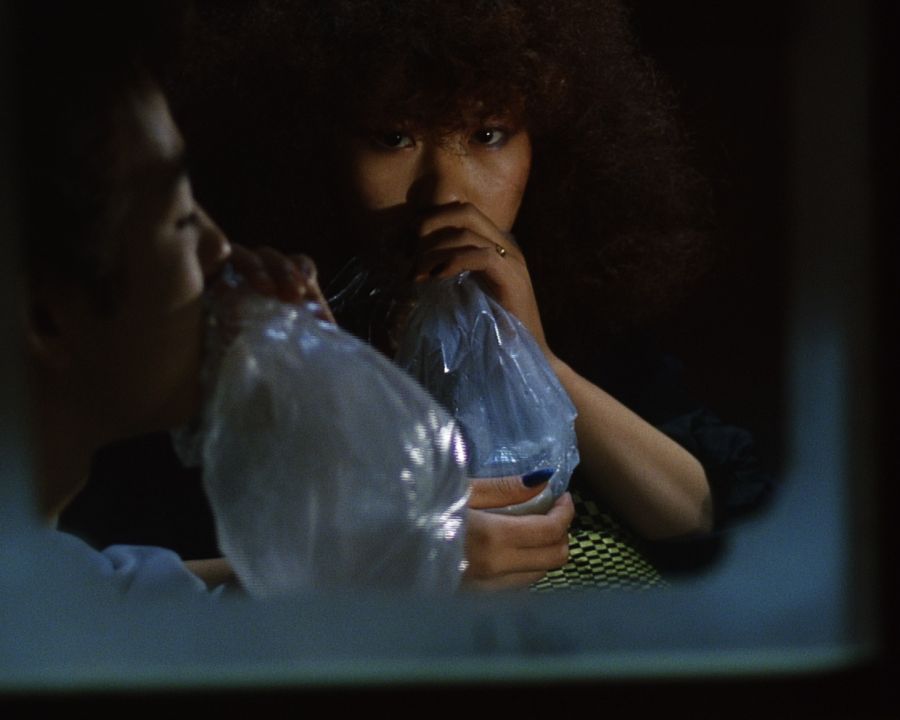
Blow the Night! ( Yoru O Buttobase ) is from the year 1983, and largely focuses on frizzy/ permed-haired Namie Takada, a non-professional actress, who appears under her own name. She plays a fifteen-year-old who moves to a rural city after many years of moving from place to place. She gets into trouble- glue sniffing, attacking teachers, and general chaos.
It all kicks off with a Japanese proto-Rolling Stones band on stage, singing a song about masturbation. Next, we switch to Namie in the school office on her first day. Later, when she's home with her granny, we find out this is like the sixth or seventh move in so many years.
As the film unfolds, she starts hanging out with a gang of seniors- who do what they want/ when they want- as they butt into classes, swear at the teachers, and drag students out of said classes.
The gang are into glue sniffing- which they do during school, and this causes her behaviour to go more and more off the rails. Going from talking back/ getting kicked out of class to attacking teachers & students- lifting the skirt of one young female teachers, making out in the sick room, and break windows/ throwing chairs & tables.
This amps up to an all-out riot, where amassed students attack/ dragging along teachers, windows are broken, etc. At moments, it all gets quite intense/ terrifying - I’d say one of the most real-looking on-screen riots I’ve seen.
Takada is very good as the devil-may-care teen, who just gets more & more extreme. The surrounding cast are good/ well placed too, with both the gang members and teachers coming off believable.
The film runs at one hour and forty-eight minutes, and to be honest, it could have had some trimming here and there, as some scenes run too long, lack a point, or are repetitive. We also have a secondary storyline regarding another female teen wandering around the nighttime city, which doesn't really add much
On the whole, Blow the Night! is an effective/ impactful film, with a lead actress with a real attitude/screen presence. Sadly, this was Takada's only role.
On the extras side for this disc/ film, we have a commentary track from Japanese film expert/ author Tom Mes- who, as always, gives a well-researched/ observed track. We find out the band featured in the opening credits/ throughout the film are called The Street Sliders, and Sony gave the makers ten million Yen to be featured throughout the film. We find out the film was very successful when it was first released, and that it was based on the actual lived experience of lead Namie Takada. We find out that Namie became somewhat of a second director, and she told actors how to play their roles. He points out a few typical Chūsei Sone- where the camera just takes a set shot. Later on, he discusses how dismissive film writers & critics were of 1980s Japanese film, and the reasons for this. Points out the fleeting moments of car chasing/ action & more.
Otherwise, we get an interview with the film's producer Kunihiko Ukai (21.11). And a video essay from James Balmont, Juvenile Delinquency in ‘80s Japan (19.50). He moves from giving a potted history of delinquent crime, discussing the look/ focus of different gang cultures, the film at hand, and a few other notable films in the same genre. This is quite interesting- though unfortunately, he does have somewhat of a monotone/ flat delivery.
The finished release comes with a 0-Ring with illustrated artwork from Ryan Quackenbush.Full-height Scanavo packaging w/reversible sleeves & artwork from both films. And a twelve-page booklet with writing from Miriam Balanescu
This is another worthy release from Third Widow Films. Let's hope they have plans for more delinquent gang/ crime films down the road, as the Japanese take on the genre is most distinctive. Both films feature great scans and a worthy selection of extras.