
Rafal Kolacki — Hijra: Noise From The Jungle
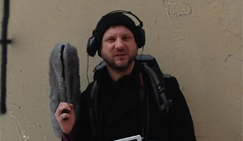
Into this stain upon Europe's conscience comes Polish sound artist Rafal Kolacki whose previous output has included recordings made in the poorer districts of Istanbul as well several more industrial and drone inflected recordings. Arendt linked the failure of universal human rights with the decay of the sovereign nation state itself and its rights of Man and Citizen. Kolacki seems to have reached similar conclusions when in his notes to the record he writes that the Jungle "is a symptom of the decay of contemporary culture, a toxic miasma from infected entrails of the western civilisation". The 27 short recordings contained on Hijra (Arabic for migration or crossing-over) were produced in December of 2015 during the wet and cold winter months when the bleak existence of those living in the shacks and tents scattered between factory walls and police cordons was especially acute. From the notes it appears that Kolacki latched onto a small community of Sudanese refugees from the vast notorious Darfur camp. What we get is a series of snapshots, many including music of various kinds along with more mundane experiences and sounds associated with life in the camp.
The four short pieces which open the record lay out the unaffected documentary quality of the work. A child plays in the distance, someone hammers at wood perhaps constructing a shelter, a group of men chant, and in the forth piece a man sings along blissfully in Arabic to a piece of popular music occasionally breaking into a whistle. The accompanying notes are entirely scant of context for the individual recordings themselves, which on the one hand opens up the material for completely unbiased reportage devoid of what could easily become a white westerners guilt driven attempt at absolution from the moral crimes of European governments. On the other hand some pieces which feature sirens, shouting and the occasional speech of aid workers could perhaps do with some explanation of the situation being recorded. It is at times difficult to distinguish between the sound of confrontation and those of revelling, at least in the case of the latter until the music kicks in! Indeed there is a surprising variety of music captured by Kolacki. Several pieces include popular Middle Eastern and East African music complete with overly autotuned singers. There is also impromptu drumming that sound very popular with the crowd and a tuning up session involving what could be a battered violin or perhaps one of the many string instruments that are particular to Sudanese music. This series of musical snapshots is cleverly broken up by a recording of what sounds like an English aid worker trying to organise a group of people into attending a women's centre in the Jungle. Without being an Arabic speaker much of the detail is lost for me but for someone fluent in that language (and its East African variants) Hijra would no doubt yield a deeper understand and experience of life in the proto concentration camp. It's particularly galling not to know what the young man rapping on one of the last tracks is saying. Sudan possessed a little known but flourishing hip-hop scene which has come to be identified as something of a unifying language allowing young Sudanese a way to express the grinding poverty and often brutal existence in that part of the world.
Tracks 19 and 21 are an amusing nod to Kolacki's drone and industrial influences being two five minute recording of the whirring and grinding sound of generator or perhaps a pump. They're the longest pieces here and are punctuated at various points by passing voices, short burst of radio noise coming from nearby shacks and during the second piece the Muslim call to prayer; all indicators that as far as possible people were holding onto those day to day rituals that give the day, even in limbo, a sense of structure. In his notes the artist writes: "Forced to exist in inhuman, extremely poor conditions, they lost their homes and families but still retain what is the most precious - human dignity". Kolacki dedicates the record to the inhabitants of the jungle whose dignity and vibrancy in the face of the wilful disregard and racism of western society he successfully captures. At this time of rising xenophobia and right-wing politics in Europe his intervention is timely one.
In a short piece written in 1943 titled "We Refugees" Arendt made the prescient statement that refugees, these people who have in effect been outlawed from the community of nations were nothing less than the vanguard of their peoples. If it is the case that the concept of universal human rights, upon which the western political tradition has for so long staked its legitimacy, has now demonstrably failed, then the need for a new concept of global citizenship independent from nation states is all the more urgent. The figure of the refugee as Arendt suggests is the best starting point for such a concept.