
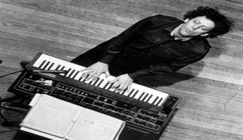
Philip Glass/Steffen Schleiermacher — Glass:Early Keyboard Music
The CD takes in five compositions (mostly from the late 1960’s), and each is prime example of early minimalism-that still sounds fairly timeless, moody, and attention locking. The whole CD has a total running time of seventy three minutes. The release comes with a twenty page booklet- this features English & German texts, discussing the tracks/ Glass’s early work, as well as a write-up about Schleiermacher career.
In the inlay Schleiermacher is listed as playing electric Organ & table- he plays all five pieces with great focus & flair. As you’d imagine most of the works here are based around extremely repetitive- to- slightly alter structures, so the amount of concentration to play this stuff must be immense, as you must have literally lock into a trance-like state to play it.
First up we have “Contrary Motion”- this track was composed in 1969, and opens the release in fine hypnotic form. The piece is built around a simple-yet-constant repeating series of tightly weaved & rapid notation- this creates a sonic sensation akin to a endless mirror corridor, where the notes just seem to continual warp into each other again & again. Glass wrote the track in what he called an ‘open form’- so in theory the work could last hours/days. The version we have here comes in at the twenty two minute mark, and is the second longest track here.
Next up we have “one + one”, and this just over five minute set, repetitive, and almost tribal like percussion tap out on a table. It’s a interest break in tone after to the last piece, but as a stand alone work it’s not very appealing…but I guess it’s important in Glass’s early sonic development.
Third-up we “Mad Rush”- this was composed in 1979, and really should be fairly recognisable to many, as it’s been used on a few films/ ads over the years, and it also very ‘Glass’ like it's circling melodic identity/ structure. The just under 15 minute track is built around two descending & ascending note patterns- these take on quite a ornate, but rapid feel, with the layers of notation building then panning back creating the feeling of a amassed group of people gathering, then thinning out- all creating a sonic feeling akin to the title.
Track number four is another version of the “one + one”, and once again it follows a fairly similar recording of table hitting, this comes in at the shorter 2.30 mark. Again it’s interesting & works as a nice stop-gap between tracks, but as a stand alone track it doesn’t really stand-up.
Lastly we have “Two Pages”, this is from 1968, and really stands as the high point on this disc. This just over twenty seven minute piece is built around a simple, urgent, yet extremely moody collection of looped notation- at times it almost comes off a darker & set cousin of the start of Oldfield’s Tubular Bells. One really does get lost & truly hypnotized by the continuing & seemingly up-stoppable flow/ pulsing of the notes & the composition structure.
All told this is a very worthy selection of early works from Mr Glass, and Schleiermacher's playing of them really is faultless. Certainly one for fans of minimalism, but I can see this appealing to fans of HNW/fixed static texturing too.