
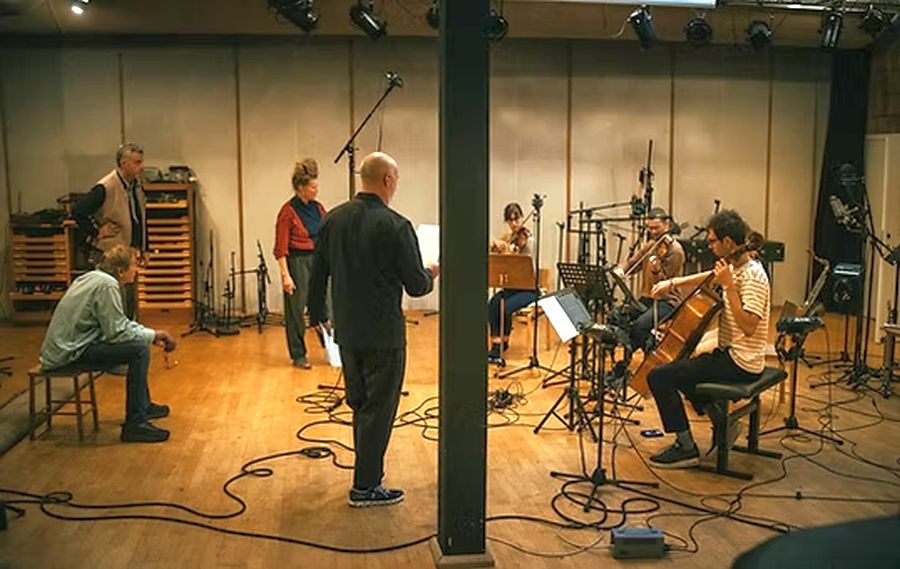
Paper Trio — Light in the Dark - Music by Carl Nielsen
Paper Trio consists of Danish musicians Thomas Agergaard (reed player) and Randi Pontoppidan (vocals) as well as American double bassist Greg Cohen. Here they have delivered a classical recording of music by Danish composer Carl Nielsen, who lived during the late Romantic period and early 20th century. His music retains the sweet tunefulness of earlier Romantic styles, but is structurally more freeform, like much of what was coming out in the early 20th century. This is generally my favourite era of classical music, containing my favorite composers such as Debussy and Mahler. Compared to these, Nielsen might be called a 'neo-classicist', akin to Jean Sibelius, although his work has its experimental moments as well. The music played here is chamber music, of course, as it is performed by a trio. They selectively choose to modernize the music in some instances, while in others they simply adapt it to the available instrumentation, and play it in a manner one might expect from a classical recording.
The recording opens with lieder for piano and female voice, a song called "Nu Er Dagen Fuld Af Sang" with singing in a traditional operatic vibrato, and a melody similar to (derived from?) "Hark the Herald Angels Sing". This very singable style of lieder will return periodically throughout the album.
Lush strings join for the second piece, "Dream of Dreams", a hazy, darkly surreal piece which seems to differ from much of the rest of the album, with eerie dissonance from saxophone and female voice. This and the following, the titular "Light in the Dark", verge into soundscape territory, floating in an absence of meter, with tonal lines sounding almost improvised, intersecting in a vague way that I can hardly imagine being possible to write on a page.
We return to more classical-sounding material with the 4th "Sænk Kun Dit Hoved, Du Blomst" and 5th "Andantino". If this recording is performed by only three musicians, each must be a multi-instrumentalist, as the instrumentation seems to continuously change, with a male vocal and flute introduced for the first time in the fourth and fifth pieces, respectively, as well as a harpsichord. Thomas Agergaard doubles on both saxophone and flute, but there are also many guest musicians added to the standard lineup of Paper Trio. This allows the group to cover a wide range of Nielsen's music, from choral to orchestral, which all share in common his big, heartbreaking melodies, which are unabashedly emotional and earnest. The range of Nielsen's sounds stretches ever wider with the final piece "Melodrama", which is like a scene from a play or opera, containing spoken word performances alongside orchestral lines.
Perhaps the most gorgeous is "Motet", which certainly captures the spirit of 1500s choral music evoked by the title, though it only contains two voices, with the other harmonies handled by strings. Its strident chords are simultaneously both triumphant and mournful, fearful and existential. Nielsen's harmonic writing is peerless, indicating many years of study into chord types, scales and voice leading.
Thanks to the creators of this recording for introducing me to the magnificent work of a great composer I had not heard, who is easily the equal of his contemporaries, with a highly advanced melodic and harmonic language. Like many of the best early 20th-century composers, his music straddles the line between sweet tonalities rooted in theory and the world of avant-garde. Paper Trio and guests have performed his music expertly and presented it in a crystal-clear-sounding recording.