
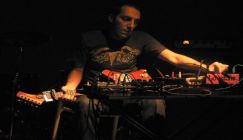
Oren Ambarchi — Sagittaria​n Domain
The track can be arbitrarily divided into two clear sections, or rather, one main section and a “coda”: the first, a long, pulsing, rhythmic passage; the second, a short section for strings. The main section builds up from bare, looping, guitar patterns till it becomes a fully fleshed out framework of different rhythms and instruments. Practically all the elements in the framework have rhythmic purpose, and they play against each other, whilst respecting the essential pulse. Thus, the acid bass “bomps”, drums (which sound live, but I suspect are programmed) and palm-muted guitar parts all interlock and accent the pulse of the piece. Its like Tortoise, or a similarly “motorik” band, at their most boring and austere; but with a clever, subtle attention to sound. I suppose you could be even crasser and say it sounds like some long lost meeting between Can and Faust, at the height of their respective powers. It certainly has the discipline of Can, with its pulse remaining consistent unswervingly; shifting from “straighter” rhythms to more bouncy, funky rhythms you might associate with Techno. Amidst the rhythmic grid, other instruments operate in more textural roles; with swirling organ drones and arcs of guitar feedback and noise entwined in the percussion.
By listing a string trio on the back of the cd, Ambarchi sets up the expectation for their usage; but its only after about twenty-two minutes that he finally introduces them into the fray. We hear string parts coming into view, but processed and picked apart by Ambarchi: their natural sonic qualities warped by phasing. The violin, viola and cello swirl around the edges of the central rhythmic charge, their clean lines contrasting the stuttering organ; though there are also sections of agitating sawing, and playing more akin to lumbering metal drones. Near the twenty-eight minute mark, the rhythmic framework suddenly crumbles away; leaving the strings to be heard in their natural state. This “coda” is introduced by a chanted word from Ambarchi, but it remains unintelligible. The lush string trio, in many respects, mirror the preceding main section; with a quietly pulsing passage that is as insistently rhythmic as that which came before. But for all the busy, grid-like playing; there is a sedateness to the “coda”. To some extent, this stillness is created by the lushness of the strings, and the connotations of their sounds; but its also a testament to Ambarchi’s composition that something so rhythmic and fast can still sound so calm.
This is the first thing I’ve heard from Oren Ambarchi, and from what I know of him, I imagine that this is an unusual release for him. It didn’t set my ears alight, but it makes something engaging of the “post-Can post-rock” thing, which is praise enough - and I would love to hear him make a companion album to “Sagittarian Domain”, that was primarily strings with a more “rock” ending.