
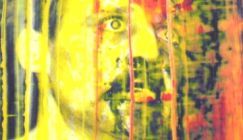
Nurse With Wound with Graham Bowers — Excitotoxicity
The first two installments of Steven Stapleton's collaboration with Graham Bowers left me rather cold. Both Parade and its predecessor Rupture seemed hastily composed, lacking coherence and relying on an irritating overuse of synthesized or otherwise artificial sounding instrumentation. Stapleton's characteristic use of space and tension has over the last few years appeared less and less at the heart of Nurse With Wound's work. Whether this is down to the influence of his collaborators or whether the doyen of audio Dada is just losing his touch is not clear. The result has been to render NWW's output rather indistinct, particularly so considering the never ending conveyor belt of re-issues, alternative versions, live performances and outtake compilations. So perhaps it's with some degree of surprise that I can report that Excitotoxicity is a really good record.
Stapleton once wrote that he disliked using synthesizers on his records as he felt they quickly sounded dated. Thankfully the synthesized elements so prevalent on the duo's two previous outings have been scaled back and in their place are live instrumentation courteous of Peter Benedict Gallagher and Mark Porter. The formers squalling guitar is most prominently deployed across most of the record's six tracks. Opener Chains and Gates builds up slowly with bowls and bells before Gallagher's guitar makes its appearance, first gently plucking his strings then generating walls of feedback before launching into full on psych-rock trip out groove. The odd sampling (this time including American voices discussing what sounds like sociology and race theory) and stabs of orchestral noise from the previous two records are still present but set against the groove of the guitar and percussion the whole hangs together in a way the previous records simply didn't.Porter's saxophone features in the trippy opening to The Worm Within which like most of the tracks features passages of percussion led surrealism that hark back to Nurse's Perez Prado influenced era. What stops this record from quite reaching those heights is the hackneyed use of synth and soundtrack samples to artificially ratchet up the tension; a technique that has unfortunately been the hallmark of Bowers and Stapleton's collaborations. That gripe aside the composition is generally of a far greater standard than many recent Nurse records and the variation in mood and use of light and shade is a big step up. Dancing Tiger revolves around bowed strings, bells and disjointed percussion using piano and metal objects. A sped up version of Homotopy to Marie might be a fair description.
Stapleton has always had an acute understanding of the creative use of feedback. French Musique Concrete composer Pierre Henry's Le Voyage composed entirely from closely controlled feedback is an obvious touchstone, and on Excitotoxicity sounds are fed back on themselves and manipulated into fine webs of atmosphere and uncanny ambience. These layers form brief pastoral lulls out of which chaos and squall can dramatically emerge. Broken Symmetry completes the album on an especially addled note mixing together thumping industrial percussion and pre-war sounding brass band music. Again Gallagher's guitar and Stapleton's subtle atmospheres just about hold it together even though it's straining at the seams!
The CD comes in a lavishly presented eight panel digipak complete with the customary Stapleton artwork. Not a Nurse classic by any means but certainly one of their most challenging and coherent releases of recent years.