
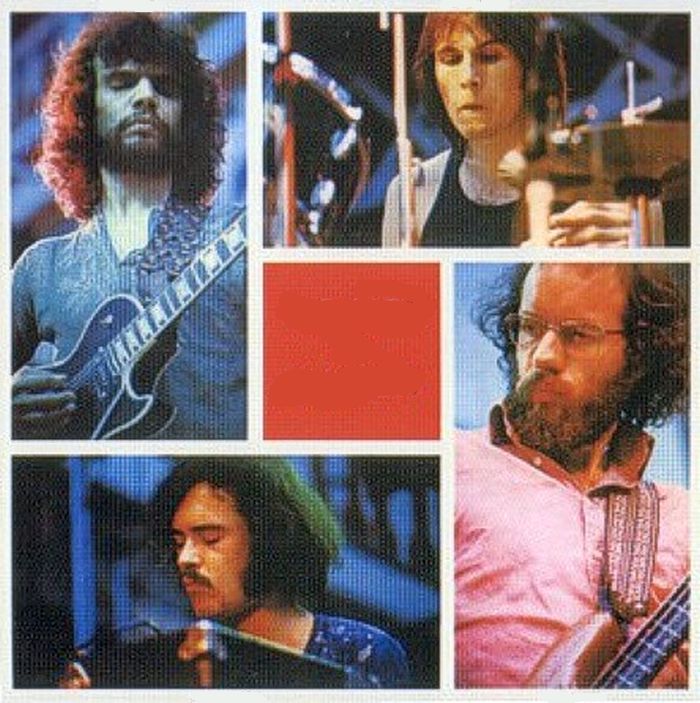
Isotope — Upward Curve- The Recordings 1973-1976
Upward Curve is a CD box set bringing together all the 1970’s work released by the British fusion band Isotope. The four-disc set takes in three albums, BBC live recordings, and rare tracks. The material here goes from knotty, complex and raw. To more groovy & atmospheric fare.
The release appears on Esoteric Recordings- Cherry Reds ' prog-focused sublabel. The three CD’s- each in its own card slip, with original artwork. It comes presented in a thick & glossy flip-side box, with a brown and white colour scheme. With a sixteen-page inlay booklet, taking in an eight-page write-up about the band, full album credits, and pictures.
Isotope were formed in June 1972 by jazz-rock guitarists Gary Boyle. In the 60’s, he was in the folk rock band Eclection, and The Echoes- which was Dusty Springfields band. Going on to do session work with the likes of Keith Tippett, Mike Gibbs, Mike Westbrook, Stomu Yamashta, Bert Jansch and Norma Winstone. Boyle seemed the key/ main band member with a shifting line-up. In all, they have released five albums to date: Isotope (1974), Illusion (1974), Deep End (1975), Live at the BBC (2004), and Golden Section (2008)
On disc one, we have the band's self-titled debut album- this was first released in June of 1974 on Gull Records. The lineup was Gary Boyle- guitar, Brian Miller- keyboards, Jeff Clyne- bass, and Nigel Morris- drums. It’s a nine-track affair, which moves the upbeat and bounding “Then There Were Four” with its focus on throbbing ‘n’ bobbing bass, and continually cascading/slightly distorted organ tones. Onto the lightly simmering & curling organ playing, stirring percussion, hazy guitar tones of “Sunshine Park”. In its second half, we move from the steady beats, bobbing organ notion, bobbing bass line and noodling jazz rock guitar tones of “Retracing My Steps”. Onto bounding ‘n’ throbbing “Honkey Donkey” with its galloping bass guitar runs, organ & guitar jazz/ prog rock jamming, and tight sparing percussion. As 70’s fusion records go, this album has quite a raw/ live quality about it, and one suspects it was possibly recorded live in the studio. The disc is finished off with a live set from October 1973, recorded for the BBC- it takes in three tracks, though the last track brings together three tracks. The sound again, is even more raw than the album.
Moving on to the second disc, we have the band’s 1974 album Illusions. This is a ten-track affair- with the line-up of Gary Boyle- guitar, Hugh Hopper- bass, Nigel Morris- drums, & Laurence Scott- Keyboards. Here we moved from the thick organ key, bass, and guitar groove/ stomp of “Rangoon Creeper”. Onto the bounding/ distorted bass line, snaking percussion, brighter darting keys/ guitar lines of “E-Dorian”. In its second half, we have “Golden Section’ which moves from locked keyboard jiving and stabbing guitar/ bass tones, to a more tuneful/ strolling along a sunny 70’s sidewalk groove. Onto the keen/ tight percussion, slight baying guitar & bass blends, wailing key tones of “Lilly Kong”. On this second album, there are more moments of groove & melody present, though the rawness/ live feel of the material is still maintained. This disc is finished off with two tracks recorded for the Old Whistle Test in March 1974.
Finally, on disc three, we have 1976’s Deep End. The line-up here consisted of Gary Boyle- guitar. Nigel Morris- drums. Dan K. Brown- Bass Guitar. Zoe Kronberger-Piano, Electric Piano, Synthesizer, Clavinet, Vocals. Frank Roberts-Piano, Electric Piano, Synthesizer, and Neville Whitehead- Acoustic Bass. It’s an eight-track album, and as you can see from the above line-up, there’s a lot more keyboard presence here. We kick off with bounding bass, galloping to blues-baying guitar lines, wailing-to- spiralling synth tones, and jiving organ of “Mr. M’s Picture”. Moving onto “Black Stand” with its steady up front beat, bright synth darts, grooving organ fills, bounding harmonic keys, and clean guitar line soloing. In its second half, we go from funk bass, jazz-rock keyboard work, vibe/ flourishes, and strutting guitar lines of “Attila”. Finishing off with the title track, which opens with bubbling water tones, twinkling percussion lines, and an organ key simmer. Before shifting from chopping/ bounding bass guitar groove, onto ornate yet tension piano runs underfed by the bass groove. Of the three albums here, I’d say this is the most sonically varied album- both in instrumental tone & track mood. I also say it was the most instant of the three albums, with a slightly more late 70s/early 80’s fusion feel. The CD is topped off with four early 2000’s remixers.
If you like mid to late 70’s fusion, which moves between knotty & raw, onto more grooving, tuneful, and atmospheric. I can certainly see you digging this box set, and all it has to offer.