
Fugitive Images — Fugitive Images: Selected works by Andrea Luka Zimmerman
This is a good, albeit niche, set from Second Run, with two Blu-ray discs and a booklet with lengthy, in-depth writings on Zimmerman and their works. It’s a lot to take in, but those of you interested in video art, and indeed art itself, will find much here to mull on. The set has a few long films and then smaller pieces, all produced between 2009 and 2023, bound together by the numerous common threads and themes to be found in them.
First up is Taşkafa, Stories of the Street. It’s a documentary, with a slight artiness, about street dogs in Turkey. Centred on the Galata neighbourhood of Istanbul, Zimmerman follows these stray dogs around the streets and interviews locals about their relationship with the creatures. The head dog is called Taşkafa, old and slow now, but still ruling the main square - indeed there’s a good quote where someone says that the dogs represent an echo of the streets past, and that they own the streets. So there are endless stories and memories of Taşkafa and his throng, constantly reiterating how embedded the dogs are in local lives. In that regard, the film is an interesting meditation on the relationship between humans and animals, and at points this is explicitly discussed, and wider societal meanings are taken from the stray dogs’ lives. The dogs, loved, fed, and cared for - acts which some interviewees link to their islamic faith - are threatened by gentrifying newcomers, who want chic streets and living, and indeed, way back in 1910 thousands of dogs were dumped on a nearby island in an attempt to clear Istanbul of their presence. The film, which also features lots of stray cats, is broken up with short abstract sections featuring spoken word quotes from the writer John Berger, but these are really the only visual frills on an otherwise unelaborated film. Taşkafa, Stories of the Street has some compelling ideas in it, but at times it’s perhaps a long watch.
Estate, a Reverie depicts the final days of flats on the Haggerston estate in Hackney, London; it was filmed between 2008-2014, with the estate demolition starting in 2009 and taking five years - after it had stood there for 76 years. The film shows the building and its occupants, who reflect on their lives there, the forced displacement, and their futures. Zimmerman narrates the sometimes turbulent history of the estate, labelled a problem area by the State and media, but also delves further back to list some of the famous persons associated with the area: Edward Halley, for example, the namesake of the comet. The film allows the occupants to tell their stories and document their lives, as they live dotted around the estate between boarded-up flats. One tells how someone opened up a boarded flat and renovated it for someone in need, only to be roughly evicted by the council. The State reappears frequently as a malevolent, uncaring, distant force, but also as an inept Social Service who mean well but are ineffectual. Some of the residents are in dire need of assistance which they don’t receive; one almost lives a hermitic life, unable to leave their front door, some live in severe poverty, and there’s perhaps a tension here in the film between the genuine working class community that exists and is documented, and some members of that community who fall through the gaps. In that regard there are nice scenes of residents sat talking to each other, discussing their lives together on the estate. Often a clued-up class consciousness is articulated, without recourse to overt political discussion, and these are voices historically excluded from the media and national narratives. The themes of home, community, domesticity, and gentrification saturate the film, without being hammered home by any forced narration. It’s a sad film, and angry at times, but also joyous and celebratory: some of the boarded-up windows are covered with portraits of people (residents, I assume) and there is a melancholy air, like the last day of a holiday; a sad farewell to a place of joy and belonging.
After this, there are some shorter works. I Am Here is essentially a four-minute summary of Estate, a Reverie. More Utopias Now! interviews children about their personal visions of utopia; it’s interesting, and feels like a venture that would indeed help, even in a tiny way, to making the world a better place but whilst it would be a good regular feature on television, for example, it’s not thoroughly compelling in itself. Birdboy and the General is a short film combining footage from Georgia with puppetry to tell a fantastic fable; the puppets are good, and there’s some nice footage of caves or homes carved into a mountainside but otherwise it’s somewhat slight.
Art Class is a 47-minute-long exploration of - surprise - art and class. Zimmerman briefly introduces their upbringing, before delving into the themes of the film, using a mixture of footage from their films and various people speaking to camera. It’s by turns dense, playful, self-reflective, satirical, and angry, analysing what it means to create art as a working class person; it requires a rewatch to fully grasp its intricacies, but it’s a provoking and inspiring film, which details the bad but ends on the positive.
Following this, Merzschmerz is a quartet of short films featuring one person performing a Kurt Schwitters story to another person; the stories are: Lucky Hans, The Good Man, The Flying Fish, and Once Upon a Time There Was a Tiny Mouse. It doesn’t really amount to much. Shelter in Place is a rare example on the set of more overt experimentation, with a split screen depicting three small, separate film feeds. Each portrays an aspect of the life of Philocus, an artist, during time they spent homeless and living in a park during the 2020 Covid lockdown. It’s engaging enough, but would be more affecting on a large gallery screen, and not my small television. Lastly, Civil Rites is a fascinating film that tours and tells stories of Newcastle, guided by race and poverty. Martin Luther King received an honorary doctorate from Newcastle University in 1967, and his acceptance speech and visit to the city anchors the film, whilst it slowly moves between fixed shots of key locations representing Newcastle’s history of civil resistance. Some of these locations are marked by plaques; others are now ghosts marked by new buildings. It’s a strangely calming film, despite the oppression and hardships described by various voices on the soundtrack, and Zimmerman charts the film from dawn to dusk. For me, it’s the most accomplished work in the set. The first disc is finished with An Appreciation by Penny Woolcock, a short film that does what the title suggests; Woolcock discusses the class aspects of Zimmerman’s work, as the filmmaker listens to voices not often heard, and also points to the fact that most of the films are joyful, not pity-laden.
The second disc begins with Erase and Forget, an incredible, fascinating depiction of Bo Gritz (1939-2026), a US Special Forces soldier and all-round American hero… who later became a vocal conspiracist, running for President and warning of the dangers of the ‘deep state’ and US government elites. The opening scenes establish the film beautifully: Gritz speaks at some kind of militaristic, patriot meet-up, and within an hour, one of the attendees commits suicide. Gritz’s entire life is surrounded and fenced in by war, the tools of war, and the destructive results of war. He sleeps with weapons next to him and confesses that he feels alone. At one point, he estimates that he’s killed 400 people in combat, and also attempts to describe the euphoria of killing. He returned from service in Vietnam to a country he no longer recognised or felt part of, somewhat lost, and I’m drawn to a comparison with the birth of Italian fascism in those returning from the trenches: they had changed and their homelands thus needed changing. Zimmerman does indeed interview a few veterans, who are clearly affected and scarred by their combat experiences. Gritz later undertook several private missions into Southeast Asia, in search of US prisoners of war; these missions were funded in part by Clint Eastwood, no less, and furthermore, William Shatner himself bought the rights to Gritz’s life story. This filmic angle is constantly pursued by Zimmerman through referral to the Rambo films that so resemble Gritz’s character and legend, and through this they question themes of hero construction and patriotism, and the role that Hollywood plays in US warfare and imperialism. The trajectory of Gritz’s political career took him into far-right Christian patriot circles, and he even appeared at the Ruby Ridge siege, helping to bring it to an end; there’s footage of an unfortunate interview where he denied giving a Nazi salute to some of the extreme right elements at the siege, only for film of the salute to be shown… Gritz founded his own enclave in Idaho, named Almost Heaven, where true patriots could live according to the constitution, and it was here that he survived a suicide attempt in 1998. It’s a fascinating film, about a fascinating person; Gritz appears haunted by war and unable to escape its characteristics and repercussions, and Zimmerman coaxes out these themes beautifully.
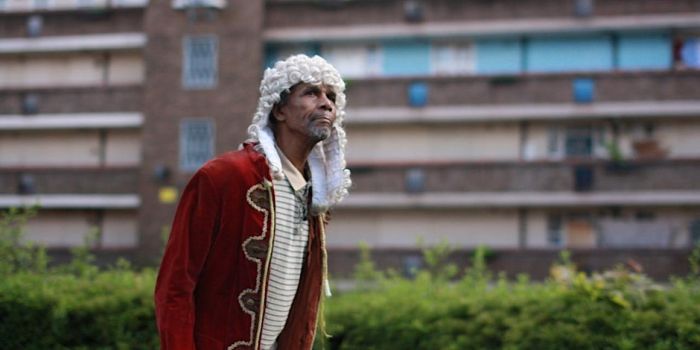
Out of the longer features in the set, Here for Life, up next, is the weakest for me. It follows working-class Londoners telling and exploring their stories, filmed around London, and often taking place in a community garden. The film blurs documentary and drama, and like Estate, a Reverie there are frequent articulations of class and marginalisation; however, the dramatic sections are less engaging for me, and the whole film feels like a somewhat unsuccessful experiment. There’s a behind-the-scenes feature which offers a tiny tour of Brixton but not a whole lot else. Finishing the set off, there are music videos for Wayfaring Stranger by Fern Maddie, and the more enjoyable Gelem Gelem by Balamuc, as well as Sounding the Voices, an hour-long audio program for Resonance FM featuring a collage constructed from six women talking about the the violent troubles they’ve endured in their lives. The voice and stories are compelling, but the music - a bed of low key electronic drones and sounds - is a little distracting. The collage is followed by a provoking and stimulating discussion of violence, trauma, and art. The final film is another appreciation of Zimmerman, this time from Gareth Evans who presents a long, detailed, and articulate commentary on Zimmerman’s work, beginning with the key observation that their films start as resistance but end as proposals for new ways of living and being. Evans draws attention to the radical political nature of Zimmerman’s works and also points to a shared value with John Berger: both highlight the difference between letting someone speak and listening to them, with the second creating a fruitful, positive feedback loop. It’s an engaging commentary, all told. The discs also feature trailers for Taşkafa, Stories of the Street, Estate, a Reverie, Erase and Forget, and Here for Life.
Fugitive Images won’t be for everyone, but it is something that everyone should see. It has high points (Erase and Forget, Taskafa, Stories of the Street, Estate, a Reverie, Art Class, Civil Rites) and low points, but the vision and themes within are vital and provoking, prompting us to think about community and sociality. It’s perhaps not a collection I’ll return to often, but it’s one that insists I ask myself questions about the world and my place and role in it.