
Forbidden Planet — Forbidden Planet( UHD/ Blu Ray)
From Arrow Video, both in the UK and stateside, is a release of one of the classic slices of cinematic sci-fi, Forbidden Planet. From the late fifties, the film blends epic other-world backdrops, memorable sets, iconic robot design, and a wonderful ahead of it’s time/ influential electronic score. The film is set in the 23rd century, where a United Planets starship is dispatched to the distant planet to determine the fate of an earlier expedition. It’s a captivating blend of sci-fi wonder and adventure into the unknown, with a keen sense of mystery and unfolding awe. This new release comes as either UHD or Blu-ray; it features, for the first time, the original Cinemascope aspect ratio of 2.55:1 with its theatrical "Perspecta" stereo soundtrack and a new 4K restoration. With a new commentary track & appreciation of the score, and a good selection of archive extras.
Forbidden Planet is a US production from the year 1958. It was directed by Tazewell, Virginia-born Fred M. Wilcox. Between the early 1940’s and early 1960s, he had ten features to his name. These included two Lassie films: Lassie Come Home (1943) & Courage of Lassie (1946) - for those who don’t know/ weren’t old enough to remember- she was a heroic Collie dog who featured in both films and several TV shows. Otherwise, there was family drama The Secret Garden ( 1949), motobike cop focused crime action/ drama Code Two (1953), and the controversial, when first released, racial drama I Passed for White (1960).
The film opens with circular/ bold yellow text set against a star-filled backdrop credits. Then we get the first view of United Planets Cruiser C-57D- a large flying saucer spaceship- and shortly go inside. The crew is led by the seemingly prim and proper/ shouts when needed Commander Adams, played by a brill-creamed/ almost unrecognisable Leslie Nielsen ( The Naked Gun Films).
The C-57D is on a mission to Altair IV- a planet in deep/ distant space, where a group of explorers had been sent several decades back, and Earth mission control hasn’t heard anything from them since.
As they near the planet, they start scanning it; there is seemingly no sign of buildings or any other structures. Though they detect a radio signal, a voice comes through, and it’s one of the explorers-Dr. Edward Morbiu. He says there is no need for them to land; everything is fine- and just go home. He keeps trying to put Commander Adams off, but over time he gets worn down- but warns that ‘it’s his fault if something goes wrong’.
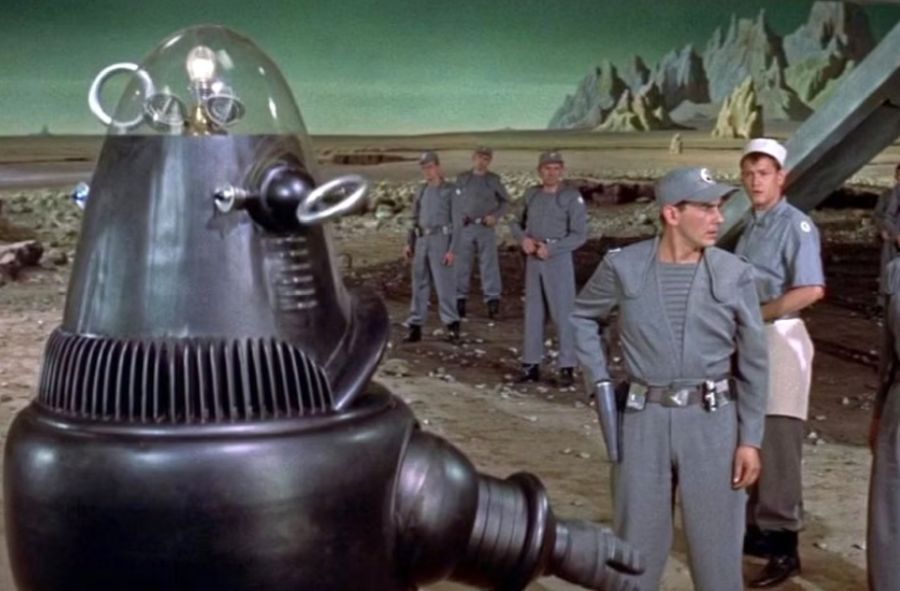
They get landing coordinates and put their saucer down on the green skied/ twin mooned planet. As the Commander and two other key crew members- Lt. 'Doc' Ostrow (Warren Stevens) and Lt. Farman (Jack Kelly) get their first view of the new world, something at great speed is coming towards them, blowing up a rapid line of dust. And here we meet one of the films key/ iconic characters, Robby- a tall & wide robot with short/ stubby arms and a glass head full of wiring, electronics & cogs, and a strip-light-like mouth.
The three climb on the craft he’s driving, landing soon at the sleek/ 50’s looking home of the goated and black-shirted Dr. Edward Morbiu ( Walter Pidgeon). Robby feeds them, and Morbiu seems charming enough- but there’s one big question skimmed over/left unanswered: what happened to the rest of his team. And then, one of the house's archways appears a young blond haired/ skimpily dressed ( for the 50s)- this we find out is Altaira (Anne Francis)- the doctor's daughter.
As the film unfolds, we get a mix of adventuring sci-fi, mystery, and light horror ( the film's creature is huge & invisible). With subtle touches of humour coming from either the interaction between the crew of the craft & the doctor's daughter, or the craft's cook ( Earl Holliman), who convinces Robby to create booze for him.
The look of the spaceship, the Altair IV planet- both its exterior & interior are most impressive. Robby is a distinctive-looking robot, with some nicely subtle sarcastic/ humorous touches to his dialogue. Both Pidgeon and Francis are good as our mysterious planet dwellers. Nielsen is passable, I guess, but I’m afraid aside from Holliman, the rest of the crew are rather bland/ forgettable… and this is not helped by their grey/ bland uniforms.
The other impressive/ ahead of its time element of the film is its score by Bebe & Louis Barron. It’s a purely electronic affair- which shifts from swirling ‘n’ pulsing space bays, on to throbbing ‘n’ purring alien sound-scaping, through to whooshing ‘n’ droning intergalactic drifts. You can clearly hear it went on to inspire the early work of Tangerine Dream, as well as spaced-out sound craft in general, be it noise, ambient, or improv.
Simply put, Forbidden Planet is a impactful/ important sci-fi, and needs to be seen by anyone who is even vaguely interested in the genre.
I’m reviewing the Blu-ray version of the release. On the first disc, we have the film- the new 4k scan certainly is lovely looking, with the unearthly colours and special effects really popping. The film features a new commentary track with film historians Kim Newman and Barry Forshaw- and as we’ve come to expect from these track pros, we get a most informative and interesting track. They begin by talking about where/ when they first saw the film- Forshaw saw it on the big screen when it was first released, so it had a massive impact on him. They talk about how the film is roughly based on the William Shakespeare play The Tempest and point out which characters relate to those in the original play. We find out the original pitch/ story for the film was based on Mercury, with the title of The Fatal Planet. They talk about how actor Walter Pidgeon didn’t like the film/ was somewhat below him compared with previous parts he’d had. They point out the cast as they appear, noting that many of the cast had come from either a western or war film background. They touch on the film's invisible monster- why it works so well- and other films with the same element that were not as successful. Later on, they talk about the film's most overused footage- the flying saucer footage. They discuss Robby The Robot- finding out he cost one hundred and twenty-five thousand dollars to make. They talk about how the film very much went onto inspire/ influenced Star Trek; it was only a moderate hit when first released, and much more.
On the second disc, we find a good selection of mainly archive extras. The only new extra is Unearthly Aura (23.29); this is a filmed appreciation of Bebe & Louis Barron’s pioneering electronic score by historian and composer Neil Brand. And is most fascinating- we find out the husband-and-wife team were best known as avant-garde artists. He talks about how they created their soundtrack work- with a use of electronics, which often pushed to the point where they exploded, and various tape decks. How the pair got the job of creating the score. He talks about key cues in the score, and more. All in all, a well-worth-the-watch extra.
On the archive side, we have the following: Watch the Skies!: Science Fiction, The 1950s and Us documentary (55.31) Amazing!: Exploring the Far Reaches of Forbidden Planet, documentary ( 26.37) Robby the Robot: Engineering a Sci-Fi Icon featurette 13.45); Deleted Scenes ( 13.15).Lost Footage ( 9.23) The Invisible Boy, a bonus 1957 movie featuring Robby the Robot in his second feature film(129.31) Robot Client,” an episode of The Thin Man TV series featuring Robby the Robot (25.36). Two excerpts from MGM Parade ( 6.00). Original Shooting Script, Theatrical trailer, and Image galleries
The finished release comes with a reversible sleeve featuring original artwork options and a double-sided fold-out poster. Reversible sleeve featuring two original artwork options. Inlay booklet containing new writing by critics Frank Collins and Johnny Mains, plus select archival material.
I’m ashamed to say this is my first proper/ full viewing of Forbidden Planet, and it certainly stands up to the test of time, still been a impactful/ engaging 50’s sci-fi film. The new scan here looks lovely, with a good selection of extras too.