
Film Noir Classics Double Feature: Borderline & D.O.A. ( — Film Noir Classics Double Feature( DVD/ Blu Ray)
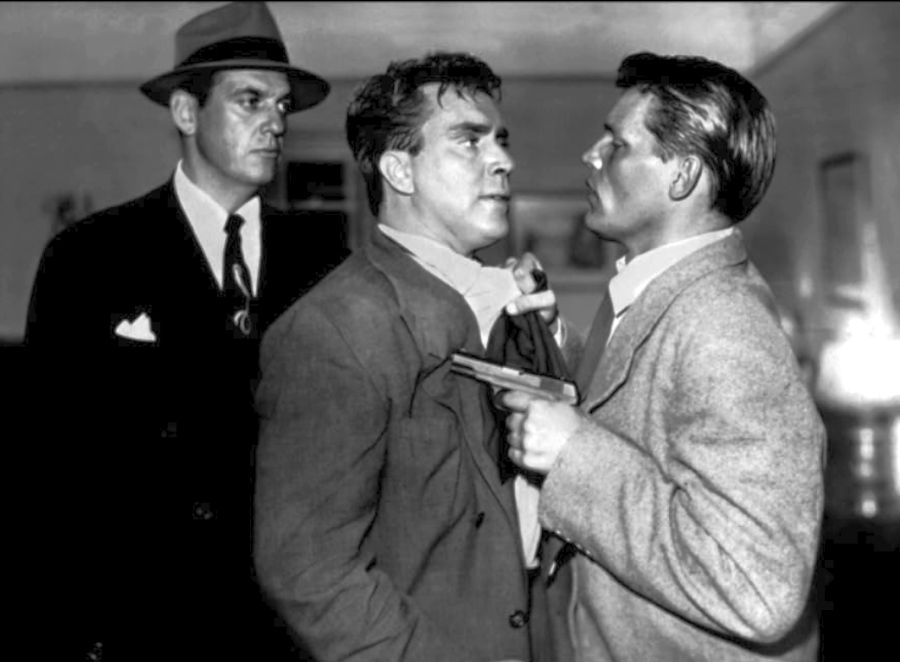
From VCI Entertainment, here’s a dual DVD/ Blu Ray release of two classic examples of the cinematic noir form. From 1949, D.O.A regards a man trying to solve his own murder before the poison inside kills him. And 1950’s Borderline focuses on an undercover female agent trying to break into a Mexican drug smuggling ring, and ends up with more than she bargained for.
The first film here is 1949’s D.O.A, which is a suspenseful blend of who-done-it, noir and mystery. It concerns a man who's been given poison and only has a limited time to solve who did it/ possible save his life.
It was helmed by Kraków, Malopolskie, Poland born Rudolph Maté- a talented/ prolific cinematographer turned director. Between the late 40’s and early 60s, he had twenty-eight feature-length directorial credits to his name. These took in the likes of sci-fi action film When Worlds Collide (1951), Classic western The Violent Men (1955), historic epic The 300 Spartans (1962), and island-set romantic comedy Aliki My Love (1963).
The film opens in classic noir fashion- as we see a POV shot of a man pounding through streets, then into a police station, rushing to tell his story in flashback. The man in question is darkly quaffed/ middled aged suited businessman Frank Bigelow ( Edmond O'Brien)- he wants to report a murder- he has a very personal connection with the victim, as it’s himself.
So the flashback kicks off in his small town offices- after a busy day, he suddenly decides he wants a few days away in the big city- so he has booked a hotel room in San Francisco. His bubbly-if-slightly trying blond secretary/girlfriend Paula Gibson(Pamela Britton) is keen to join him on his trip, but he says no.
As soon as he gets to his hotel in San Francisco, his eyes are on Storks as women pass by- with this very ill judged/ embarrassing comic sound being played each time- he looks a woman up & down- thankfully, this doesn’t last long.
He goes out to a rowdy and crowded jazz bar with a group of people, but gets fed up with one rather bothersome woman talking to him. So he heads to the bar to get another drink- he orders, it’s poured & then a glamorous woman at the end of the bar captures his eye. So he rushes over, leaving his drink- just before he can ask the barman to pass his drink, it’s switched for another by a person wearing a polka-dotted scarf
Back at the hotel the next morning, he’s not feeling too good- but it seems more than a hangover- so he decides to visit two different doctors. Both agree he has been poisoned, and that it’s a murder case.
This understandably throws him out and panics the ladies' man- with the rest of the film seeing him trying to find out who poisoned him, and if he can be saved. Throughout it, he’s constantly phoning back to his office to talk to Paula- who shifts between being loving & rather frustrated with him, as for some reason he won't tell us the real reason he’s in such a panic.
Edmond O'Brien plays our lead well, and you really do shift between feeling concerned/ worried for him, and rather thinking he’s been dealt a form of karma for his flippant treatment of the doting Paula. The rest of the cast is largely good too.
As we move through D.O.A, we get a good sense of building suspense, with a few moments of gunplay and a few chases. With you being well & truly held throughout the film's one hour and twenty-four-minute runtime, wondering if he’ll figure out who done it & if he’ll save himself.
For this film, we get two short visual essays- The Man Who Made Every Second Count ( 4.52), looking at the career of lead actor Edmond O’Brien, and how, after serving in WWII, he returned to play roles in a series of noir films like the film to hand and The Barefoot Contessa ( 1946). Though we find out he had a fairly genre-varied career, going on to notch up nearly one hundred roles over his lifetime. The Eye Behind the Shadows 5.14), which looks at the career of director Rudolph Maté- first, discussing the film to hand, before talking about his wider career.
The second film here is 1950’s Borderline. This focuses on an undercover female agent going into Mexico to try and get information on a drug smuggling ring, and getting more than she bargained for. The film brings together crime drama & thriller- with light, subtle touches of humour and romance.
It was directed by New York City born William A. Seiter. Between the early 1920’s and 1950s, he had an impressive one hundred and thirteen feature credits to his name. These included the likes of romantic comedy Hearts and Masks (1921), screwball comedy If I Had a Million (1932), musical fantasy comedy One Touch of Venus (1948), and sports crime drama Champ for a Day (1953).
The film focuses on bawdy, brash, and blonde Madeleine Haley (Claire Trevor), a drug agent who goes undercover over the border in Mexico. She starts dancing in a club, trying to snuggle up to broad-shouldered and barrel-chested Pete Ritchie (Raymond Burr), who owns the club and is involved in drug smuggling.
Things start looking promising as she gets upstairs into the club, taking photos, but then another dealer, Johnny McEvoy (Fred MacMurray) bursts in- he snatches Madeleine and is fairly soon heading back to the border with drugs hidden in the bottom of a parrot cage & musical box. With Ritchie and his goons following.
As the film unfolds, there are threats of gunpowder torture, dusty back-road car and motorbike chases, nighttime hotel escapes, lots of bickering between Johnny and Madeleine, an aeroplane crash-lands on a beach, and a rather surprising twist on who one of the characters really is.
Cast-wise, Trevor and MacMurray have good chemistry as our leads, as they move from being pushed together/ disliking each other to friends/ maybe more. The supporting cast is largely good too, with Burr being great as our white-suited, always-popping-up villain.
Borderline is a pacy and entertaining noir, which blends in nicely drama & thriller elements- with light/ effective touches of humour and romance.
Once again, there are two video essays for this film. From Noir Shadows to Disney Light (3.08) which looks at the career of lead actor Fred MacMurray- who we find out started his career as a saxophonist. Hollywood’s Hidden Craftsman ( 4.22), which discusses the career of director William A. Seiter- who had a decidedly genre-shifting career, going from comedy, noir, and beyond.
Film print-wise, both are okayish; it doesn’t look as though they've been given any sort 2 or 4 K treatment. So, I’d say they're the equivalent to a DVD scan, with the balance between the black and white tones good enough. The extras are interesting enough- though they are a little short- and they were created by Chat GPT/ AI.
In conclusion, if you’re a fan of cinematic noir and haven’t seen these two classy examples of the genre- go a pick up a copy of the set.