
Essential Film Noir- Collection 6 — Essential Film Noir- Collection 6( Blu Ray boxset)
Here we have the sixth in Imprint's excellent Essential Film Noir box sets. The Blu-ray box set features four films dating from between the mid to late 1950’s. As with the other sets in the series, we get a nice selection of different takes on the noir genre. We go from a police drama-focused thriller. Onto a circus performing drama, escaped madman thriller, and noir blend. We have a mix of noir, romantic drama, and island/ holiday set adventure. And finally, a Bahamas-based melodrama and noir mix,
The set is a hardback box affair, which classily blends moody black-and-white film stills with minimal blue texts and colouring. Each of the films comes presented in its own Blu-Ray case- these feature double-sided covers- on the front film poster artwork/ specs, and on the reverse a single still from the featured picture. Each film gets a classy new scan- these are both nicely crisp, clean and well-defined prints. There is a new commentary track for all but the last film, as well as a selection of other new/ archive extras.
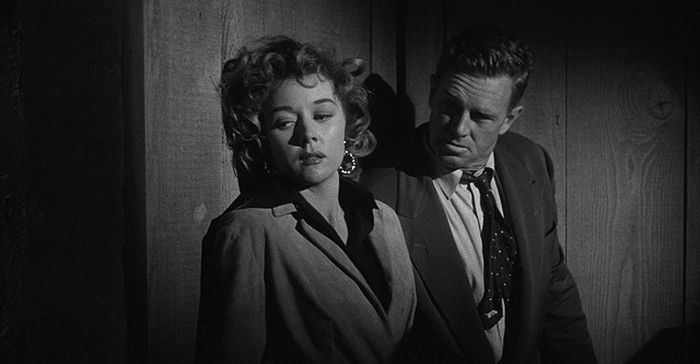
The first film in the box set is 1954’s Naked Alibi, and it’s a great police drama-focused noir, with tons of atmosphere, effective rough ‘n’ ready violence, and some classy acting- so a great start to the set
The film was helmed by Jerry Hopper, a Guthrie, Oklahoma-born director. He was mostly known for his US TV series work, having sixty credits between the 50s and late ’60s, for shows such as Leave It To Beaver, Gunsmoke, and Voyage To The Bottom Of The Sea. Though he also had seventeen features to his name- these went from Cold War thriller The Atomic City (1952), US Cavalry-focused western Smoke Signal (1955), charming comedy Everything But The Truth (1956), and gunman meets nun western Madron (1970).
The film opens with baker owner Al Willis (Gene Barry) being questioned late at night by the police, as he was causing issues in a bar, and they suspect he might be involved in a murder. He keeps insisting he’s a businessman & was just having a few drinks. He seems very tense, and at one point lashes out, breaking a bottle over an officer's head- making clear the officer will pay, this, of course, increases suspicion- but when they get an ID check back, all seems fine. And he is, as he suggested, the married owner of a local bakery, with no criminal record, so he is allowed to go home.
The same night, the officer he threatened is gunned down in the street, but Al has an alibi- he was working with witnesses. But police department head Joseph E. Conroy (Sterling Hayden) still thinks he had something to do with it, and this suspicion increases when, a few days later, two more officers are killed with a car bomb. They try to arrest Al, but end up chasing him down in a park- as he runs away. Conroy is positive Al is a killer, but due to pressure from above, he’s told to stand down…he doesn’t, so is let go. Conroy's belief stays firm, and it leads him to the shady and dangerous streets of Border City- here he meets bubbly & troubled nightclub dancer Marianna (Gloria Grahame), and young shoeshine boy Petey (Billy Chapin).
Acting-wise, Barry is wonderful as baker Al, as he shifts between being a balanced businessman and a nervy/ unpredictable mess. Hayden is very believable as the focused, possibly obsessed cop. And Grahame Marianna wonderfully plays l the happy-go-lucky to decidedly tragic nightclub dancer.
From the off and the rough ‘n’ tumble interview, the film presents us with some fights & action. With along the way back street rough-ups, gunplay, a tense getaway/ kidnap, and a great nighttime roof finale. Equally, we get great moody and atmospheric noir moments, with shadowy figures lurking on night-time streets, tense and sweaty interviews, and tailings on neon-licked streets.
The picture runs at just under the one hour and thirty-minute mark, and from the off your pulled in & held throughout the film. Really Naked Alibi is a truly excellent example of the film noir form and can easily be held up as a prime example of the genre.
New extras-wise on the disc, we have a commentary track from author and film historian Samm Deighan. As we’ve come to expect from Ms Deighan this is a well-researched and thoughtful track. She starts by declaring that the film hits a lot of key noir notes, though the police interrogation/ brutality scene is quite a surprise. She chats about how a lot of the actors in the film were quite prolific – often starting in theatre, going onto film, before working in TV. We get a bio of director Jerry Hopper, finding out he started his career as a war photographer in WWII. She discusses the film's key themes. Later on, she goes on to talk about the career of Sterling Hayden, as well as his brushes with communism. She points out and briefly touches on the career of the film’s child actor, Billy Chapin. She talks about the original story the film was based on, 1931’s Cry Copper, and much more.
Otherwise, on the new side, we have Shadows at the Border (15.23) video essay by film academic Eloise Ross. A recreation of the original Naked Alibi radio ad (1.16)
On the archive side, we have the following: The Cinematographer (9.31) a 1951 short film from director Jerry Hopper, and an original trailer
The second film here is 1954’s Ring Of Fear- this is in Cinemascope colour and regards a former circus director escaping from a psych ward to return to his old job, and cause danger/ chaos. It also features crime pulp fiction writer Mickey Spillane playing himself, and let's just say you can see why he wasn’t known for his acting. The film blends real-life circus performing, drama, an escaped madman thriller, and noir.
The film was jointly directed by Chicago-born James Edward Grant and Brookline, Massachusetts-born William A. Wellman. This was the second & final feature film Grant helmed- the other being 1947’s classic western Angel and the Badman. Through he had sixty writer credits. Wellman had an impressive eighty features to his name- these included circus set, love triangle drama, You Never Know Women (1926), aeroplane set, adventure Island In The Sky (1953), and wartime set political drama Darby's Rangers (1958).
The picture rather kicks off like a family-focused documentary about the circus- as we see the animals being unloaded from train carriages, as Mr voice over man talks about the acts & appeal of the circus.
We then shift to a psych assessment board, who are looking to see if Dublin O’Malley (Sean McClory) is suitable for release. After talking to him & seeing the way he responds to a photo, it’s decided he’s still insane…but just as he’s been led to his cell, he escapes. First, stealing a van, then jumping a train- at the end of his trip he knocks out another man, switches clothes & throw him on the line- so the authorities think he’s dead.
Next, he makes his way to a circus he used to work at, first getting weak-willed/alcoholic Twitchy (Emmett Lynn) to sabotage some of the acts. Then he steps out of the shadows, declaring he’s been in the army for the last six or so years- to take up the role he had before ringmaster.
To try and find out who's causing all the accidents and near misses, suited and trilby-hated circus manager (Pat O'Brien). Calls in Mickey Spillane to investigate what’s going on.
I’d say around 60 per cent of the film is focused on the circus, and their performances- we get to see a full six lion taming session, elephants performing, and high wire acts. Then, around 30 to 40 per cent focus on Dublin devious/ at point deadly plans, then the remainder, with Mr Spillane, focuses on the noir side of things.
On the acting side of things, McClory is good as the escaped patient, who switches between being cunning & manipulative, seemingly normal & balanced, to a deranged and cackling madman. Other worthy mentions are Marian Carr as the ringmaster's old flame, Valerie St. Dennis, and Lynn as fighting with his conscience, drunk. And as mentioned early Spillane can’t act at tall, and at points he barely gets his lines out.
I’ve always been a sucker for Circus set films, and Ring Of Fear is a passable example of the genre. Though if you're looking for out-and-out noir, you'll be disappointed, as it’s really only a small part of the film's genre make-up.
Extras-wise, here we have two new things- an audio commentary track from Mystery writer Max Allan Collins and Cereal At Midnight host Heath Holand. And As Themselves (13.44) video essay by filmmaker and film historian Paul Anthony Nelson.
The commentary tracks is initially very focused on Mickey Spillane, as Collins was a fan of his work, as well as getting to know/ personally work with him. But as it goes on it opens up more to discuss film in general- touching on things like the original script & how it vastly differs from the film, the lots of padding in the film, and that director James Edward Grant had a drinking issue, which caused issues with the production. It’s an interesting enough track.
Next is Hell’s Island, which is from 1955- it’s a VistaVision colour affair. The film is a mix of noir, romantic drama, and island/ holiday set adventure.
The film was directed by Chicago-born Phil Karlson. Between the mid-1940s and mid-1970’s, he had fifty features to his name. These go from wartime musical romantic comedy A Wave, a WAC and a Marine (1944). More than a fair few noirs like- Scandal Sheet (1952), Tight Spot (1955) and The Brothers Rico (1957). Western A Time For Killing (1967), killer rat horror Ben (1972), and crime thriller Framed (1975).
After the rather confusing/ giving clues at later on in the plot credits. We meet our lead, Mike Cormack (John Payne), ex-assistant DA/ bouncer. He’s lying on an operating table- just coming around, he asks for a smoke- then in classic noir fashion we flash back to the past, with voice over from the character throughout.
So, we first go back and see Mike working at his job as a bouncer in a Vegas casino- after throwing out an awkward client, he’s called to another room. Waiting for him is the tubby, balding, and wheelchair-bound Barzland (Francis L. Sullivan), he’s offering Mike five thousand dollars to go to a Caribbean island, to find out what’s happened to a large diamond. The reason why he’s chosen Mike is that his ex, Janet Martin (Mary Murphy) is with the person who flew the plane when the diamond disappeared.
So, Mike jumps on a plane- checks in to a tourist hotel, where, rather bizarrely, a jukebox seminar is happening- with in the foyer, makers are trying to sell their wares. He finds out sooner enough that Janet is living in a large cliffside house on the other side of the island.
As the film unfolds, Mike tries to balance his feelings for Janet and the need to locate the diamond. There’s a murder at a cockfight, lots of manipulation/ double-crossing, more than a few dusty/ dirty fights- with Mike's once-off white suit getting very soiled. There’s a fight near a crocodile pit, out on the high seas action, and more.
Our two leads are both good- John Payne has a rougher ‘n’ ready on Gary Grant quality. And Mary Murphy plays well, unsure whether or not to trust her red-haired love interest
Hell’s Island was an entertaining slice of cinematic noir, with some rewarding twists along the way.
The first new extras on this disc is a commentary track with film historian Gary Gerani- he has a particularly pacy delivery style and does dart all over the place a bit- but there are some great facts/ observations. He moves from talking about how the opening music cue later got used on the 1958 sci-fi film I Married A Monster From Out Of Space. And how the credits seem thrown together- though apparently these were scripted. He points out character actors as they appear, sometimes mentioning notable roles from their careers. He discusses Pine-Thomas Productions, who were behind the film- we find out they released a total of eighty-two films, as well as a few other things. We find out the film was largely shot on the Paramount backlot in LA, with some of the exteriors captured in Southwest LA. He comments on the number of cigarettes star John Payne smokes. He talks about the original story the film was based on, and the changes made- for example, it was set in Mexico. Later on, he discusses elements of the film that remind him of early James Bond films. We get a bio of lead actor John Payne, finding out, among other things, that he was a male nurse before he went into acting. It’s a well-worth track, which I may well return to.
The other new thing is The United States vs Hell’s Island (4.59) a recreation of a 1955 US Senate hearing that examined the film’s lurid advertising.
Finally, we have Flame Of The Island, from 1956. Here we have a blend of melodrama and noir, largely set in the Bahamas. It focuses on Rosalind Dee (Yvonne De Carlo) as a Legal secretary dreaming of the good life…and a large amount of money suddenly lands on her lap, she pays into a casino on the islands
The film was directed by Russian-born Edward Ludwig. He has a total of one hundred and seven credits to his name, with thirty-eight features and the remaining taking in shorts, TV shows, and TV movies. His features include sports drama Steady Company (1932), western The Fabulous Texan (1947), romantic adventure The Blazing Forest (1952), and classic western The Gun Hawk (1963).
After the beach and palm tree painting credits, we open in New York City in a legal office where Legal Secretary Rosalind (De Carlo) is working away. Her moustache colleague/ friend Wade Evans (Zachary Scott) lets her know that one of their more difficult clients, walking with a silver-edged cane, Evelyn Hammond (Frieda Inescort) wants to see her.
She heads out to Ms Hammond’s grand house, finding out her husband has recently died, and she believes that Roslind has been having an affair with him. She insists that she takes a cheque for $100,000, no matter how much Roslind protests.
Wade & Rosalind go for a night out and meet up with tubby/ brill creamed-haired Cyril Mace (Kurt Kasznar)- he tells them about a private gambling club/ hotel he’s set up on the island of Nassau.
So, the three head out to see the resort- she is very taken by what she sees- so buys in for her & Wade. And as the film unfolds, she encounters a series of men after her heart- towering blond-haired/ex-alcoholic Kelly Rand (James Arness)- who takes tourists out fishing & is one of the island's reverends. Pipe smoking, wealthy, living with his mother, Doug Duryea (Howard Duff), and a few others.
We find out the mob has a stake in the casino, though this element doesn’t really come fully into play towards the end of the picture. For the first three quarters of the film, I’d say we’re largely focusing on romantic melodrama with light touches of noir- it’s only in the last fifteen that we go all out noir- with gun play, fist fighting, and a sea chase
As our lead, De Carlo is good, and you are often unsure of her motives. She also does a couple of sassy song and dance numbers. The supporting cast is all good too, and we get a few nice twists/surprises in the plot.
Flame Of The Island is an entertaining mix of melodrama and noir. The Bahamas setting is largely effective, though some of the use of back projection/ stock footage is a little dodgy, which is unfortunate, enhanced by the lovely new scan, but thankfully, there are only a few of these moments.
There’s only one new extra on this disc. The Most Beautiful Woman In The World (36.05) a video essay from film historian Phillipa Berry, regarding the film's lead actress, Yvonne De Carlo.
This sixth volume is certainly up to the excellent standards of the other boxes in this series. With a decent selection of different types of noir, lovely clean & crisp prints, most informative/ interesting commentary tracks, and other extras