
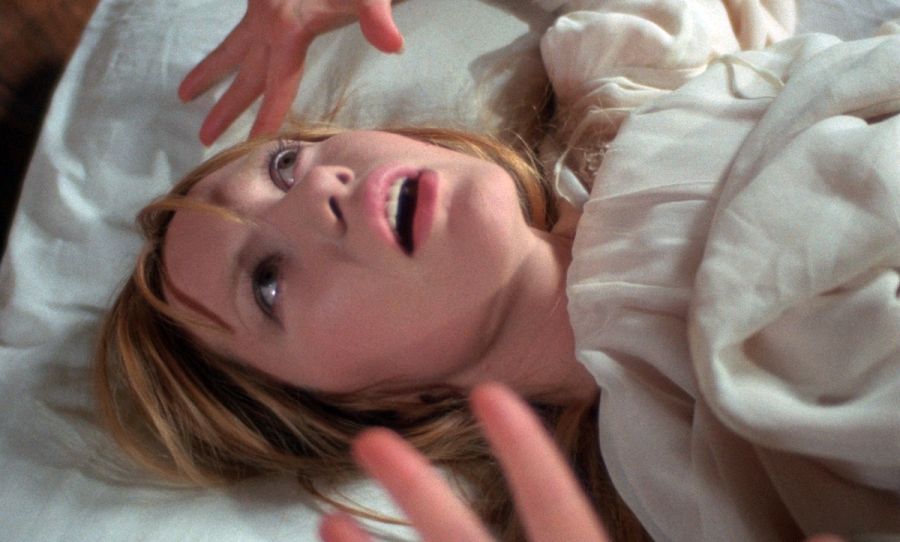
Demons Of The Mind — Demons Of The Mind( UHD)
From the start, Demons of the Mind, directed by Peter Sykes, screams Hammer. But it was released in 1972, a time when legendary British studios were waning in a fast-changing horror landscape, and the strain is clear.
The early 1970s found Hammer Film Productions on the edge. Their successful spell of gothic-tinged terror, which had run from the late 1950s, was fizzling. Their Dracula films had leapt to the modern day, while a failed, more comical reboot of its Frankenstein series had stalled with 1970’s The Horror of Frankenstein. In 1973, The Exorcist would pound a devastating nail into Hammer’s dated horror, and a year before Demons of the Mind shows the last throes of the brand. The gothic touches are there—careering stagecoaches, flaming crosses, villagers on the march, bound corpses cast off in lakes. Still, despite Hammer’s attempts to up the blood-letting and gratuitous nudity, it falls badly at sustaining a plot.
The spirit of madness hangs over Demons of the Mind, which was derived from a story by Frank Godwin, a producer determined not to be a stooge of Hammer. The film’s opening has only a smattering of dialogue as a girl (Gillian Hills) escapes a carriage, only to fall in love with her rescuer (former Manfred Mann vocalist Paul Jones) before being captured once more. She is Elizabeth, the daughter of Baron Friedrich Zorn (Robert Hardy), a wealthy widower driven to desperate measures to stop her and her brother Emil (Shane Briant) following their mother into madness.
With both under lock and key (“It can only be the way I say”), Zorn instructs the dubious and disgraced Dr Falkenberg (Patrick Magee) to treat them for madness and their unsavoury connection to each other. But outside the manor, the local village is prey to disappearances and murders—fertile ground for a travelling priest (Michael Hordern) determined to banish demons from the land.
Godwin’s determination to stand apart from Hammer leaves us with a film that feels like a distortion of classic Hammer. Not turning to their two most famous leading men, Peter Cushing or Christopher Lee—and new studio star Ralph Bates doesn’t get a look in—Robert Hardy makes a gruff lead. He chews the scenery in a film notably shot on location, removed from the classic, stagey studio work of Hammer’s peak.
While Demons breaks conventions, it musters up some atmospheric scenes under the direction of the underrated Sykes, including Falkenberg’s ritualistic session with Zorn, where a candle pivots like the moon on a simple orrery. It also musters up some delicious dialogue when it’s in the mood (“The world will be a better place without me and won’t even know that you died!” screams Hardy during the deranged final act). Then there’s the sound design at the film’s close—rifle bullets memorably careering through the trees.
But hanging between the stylish sequences—and on this restoration, the colours pop and the night sequences glimmer wonderfully—there’s not very much at all. For all the theorising and investigation, what Demons of the Mind needs is a solid plot.
Instead, there’s a lot of rumination on the issue, despite the villain of the piece being apparent from the early scenes. Hordern wailing through his sentences is always good fun. Here, his classical-character-actor weight powerfully incites the villagers with religious fervour, proving that something interesting lurks underneath. It’s not supernatural, but the fear, superstition and more that had long undercut the studio’s classic horrors brought to the fore and…Wasted. Without a palpable central threat, it all feels a little flat—for most of the hour and a half, the siblings do little but lie around unconscious or be shepherded back to their locked and separated rooms.
That lack of substance makes the graphic murders (sharp objects and necks are a popular choice) and flashes of nudity more distracting. “Blood will have Blood’ says Hardy at one point, the Macbeth quote that was apparently mooted as a title. Given the red stuff swilling around, it's funny that Hammer is said to have baulked at repeating “blood” in the title.
An interesting idea, then, and perhaps it was the right time for Hammer to dwell on the horror inside. But for all the blood, it lacks in execution.
The same can’t quite be said about this release, the latest in StudioCanal’s handsomely repackaged Hammer films. Within the striking set, which includes a 64-page booklet of essays and the original press kit, a highlight is the new feature Evil In the Blood—a retrospective look at the film with actress Virginia Wetherell. Additional commentaries with film historians and the original cast and crew make this an easy purchase for Hammer completists.