
Danza Macabra Vol. Five: The Spanish Gothic Collection — Danza Macabra Vol. Five( Blu Ray Boxset)
Here we have the fifth volume in Severin's excellent Danza Macabra series, which brings together lesser-known and underappreciated examples of European gothic cinema. As the Blu-ray set’s subtitle suggests, the focus this time around is Spain- with the set bringing together four films dating from between the 1960s and 1980’s. We go from a village drama, dark comedy and gothic mystery blend. On to a 19th-century mental asylum set drama, with touches of gothic horror & low-key exploitation. Through to one of the more original/ distinctive takes on the Dracula story. Finishing off with a homoerotic-edged take on Henry James's classic Gothic novella The Turn Of The Screw. Each film receives a lovely HD print, a new commentary track, and a great selection of new extras.
As with all of the sets in this series, it comes in a box with a removable lid, which utilises blends of artwork from each of the pictures in the set. Each film gets its own Blu-ray case.
We open with 1964’s Strange Voyage (El Extraño Viaje); from its title, you may be imagining something nautical- maybe a creaking Gothic boat movie. But the sea appears only in brief glimpses. The film is a rather haphazard blend of village drama, dark comedy, and Gothic mystery- really in that order.
Actor-turned-director Lima, Peru-born Fernando Fernán Gómez directed the film. Between the late 1950s and early 2000s, he has twenty-eight features to his name. These include the period-set comedy Sólo Para Hombres (1960), social drama My Daughter Hildegart (1977), and nasty black comedy Siete Mil Días Juntos (1994).
The black-and-white-scopéd film runs for around one thirty-two minutes, and to be honest, for the first ten or so minutes you may be thinking you’ve put the wrong film in, as there is nothing remotely gothic about it. We focus on a then-present-day dance hall/ bar where the band is playing, and we focus in on a younger, tight dress-wearing woman- who is intensely dancing- as old men leer & others dance around her.
She leaves the club to men calling after her, and she butts them away, strolling off through the Mediterranean village to her home. We then finally kick into the gothic, as we’re led into the Vidal mansion, which sits in the middle of the village. Inside lives stern-faced & black-dressed Ignacia Vidal (Tota Alba), the oldest/ head of the household; she is joined by her tubby, childlike, often scared brother & sister- Venancio, played by cult B-movie film director Jess Franco, and Paquita ( Rafaela Aparicio). Ignacia is constantly belittling & talking down to her siblings.
As the film goes on, we shift between the creepy, creaking, often candlelit interior of the Vidal mansion, as it seems Ignacia is receiving a nighttime visitor, with Paquita & Venancio either scaring themselves or playing with the two cats their sister hates. To village life- where shop assistant Beatriz (Lina Canalejas) is hoping to marry mysterious guitarist/ singer Fernando (Carlos Larrañaga), the dancing still goes on in a music hall, and we have a side plot where a corset has been stolen.
Then Ignacia decides she is going to sell off the mansion, without telling her brother & sister; a few deaths occur, with bodies being found in a wine barrel (see the film's poster) and by the sea.
Strange Voyage certainly is a curious crossbreed, as we’re constantly moving between the dark/ creepy confines of the mansion and the bright, sunny village/ it’s dance floor. We do get some nice eerie/ gothic moments along the way, a compelling enough mystery, and decent enough village drama.
Cast-wise, Alba is great as the initially unsmiling/ stern head of the household, who later has a bit of a character arc. Franco and Aparicio are really rather good as the child-like siblings, and they play off each other well. Another worthy mention is Larrañaga as the guitarist/ songwriter, who seems to have more than a few secrets.
I’d say it’s a fairly daring first choice for a gothic boxset, but it’s great to see Severin taking a risk with it, and I think it pays off- as soon as you realise the film's rewarding tonal swing.
Extra wise, for this first film, we have commentary from Dr Adrian Smith, Co-Author Of Norman J. Warren: Gentleman Of Terror. He begins by pointing out the different magazines and newspapers on the newsstand in the credits. He then does a fascinating deep dive into the 1956 true-crime case the film is roughly based on; I won’t say any more about this so as not to spoil the film's resolution. He notes that the film was shot between March and May of 1964, but it didn’t get released until 1969. He talks about how to start with it feels like two separate films, and how it clever starts to tie together as the films goes on. He discusses how the film works as a satire of what it was like to live in the real rural Spain during Franco’s reign. He chats about where director Fernando Fernán Gómez career was at this point, touching on some of his other notable work. We find out how the idea for the film came about & it’s script development. Later on, he discusses how amusing Franco and Aparicio are as the two siblings. He points out other actors as they appear and gives quotes from critical reviews of the time. All in all, a most informative/ engaging track.
Otherwise, on the extras side for this film, we have the following: A 'Rara Avis' Duo (15.22) Ángel Sala, head of programming at the Sitges Film Festival, on Fernando Fernán Gómez & Jess Franco. The Multifaceted Mind Of Fernando Fernán Gómez (24.44) Filmmaker Helena de Llanos on the work and legacy of her grandfather. Facing The Sun: Strange Voyage’s Promise Of Broken Dreams (19.33) Video Essay By Andy Marshall-Roberts, Host Of The Nasty Pasty Podcast. He starts off by discussing the film's genre shifts, comments on how it nods towards other films like Psycho, and the elements of fascism in the picture's makeup. Going on to discuss each of the film's key characters. This was an excellent essay with great observations/ points made.
Next up is Exorcism's Daughter (Las Melancólicas, House of Insane Women, Women of Doom), from the year 1971. It's got a rather misleading title, as the exorcism element is a small part of the picture's makeup. What we have here is a glum, at points grimy & sweaty 19th-century mental asylum set drama, with touches of gothic horror & low-key exploitation.
It was directed & written by Madrid-born Rafael Moreno Alba. Between the late 60s and early 90s, he had seven features to his name. These included the martial-affair crime drama Crimen De Amor (1972), sex comedy Mis Relaciones Con Ana (1979), and sexy thriller Dream Kiss (1992).
We get two versions: the Spanish and the American. I watched the longer of the two, which is the Spanish version, featuring Spanish language with English subs.
I don’t normally discuss credits, but the film has some impactful/ light unsettling ones. We get a series of inverted black-on-yellow images of the all-female asylum's patients- all topped with blood-red text.
As we move into the film, we’re dropped right into the rundown, dirty, fly-buzzing & grim asylum, with chattering and screaming patients, often filmed handheld/ close up or via POV. It’s run by a non-medical caretaker- the few days' stubble, stained/ sweat vest, and smart but grubby military dress jacket of Fuso (Francisco Rabal)- with the help of nuns. The head doctor lives in the nearby small town- he rarely goes to work; instead, he spends his time in the local casino.
Then one day, a new younger/ goateed Rafael Alba (Espartaco Santoni) is brought in to run the asylum, and he wants to make big changes- treating the women more like humans instead of animals.
From the off, Rafael clashes with the lazy/ constantly drunk Fuso, who often manipulates & beats the patients. And he’s even secretly sleeping with one of them in his bedraggled/ stable doored bedroom.
As Rafael is doing his rounds, he comes across the wild eyed/ ranting Tania (Analía Gadé), who has been separated from the rest of the hospital and gets the worst of the beatings from Fuso. So, he insists she has her own room, which she proceeds to paint white on the walls, ceilings, and floors. So she says, ‘The shadows/ evil can’t creep up on her’.
For most of its runtime, the film is more of a troubling drama. The asylum's location is impressive- going from tiled cages, onto cramped corridors, out into grand, if starkly decorated, staircases and pillared-out door walkways.
At times there is a sweaty/grimy almost spaghetti western feel to the characters/ their interactions; at others it's more tragic gothic meets mental unwellness.
Part of Rafael updating/ treatment of the patients is hypnosis, and this is where the exorcism / possessed by demons element comes into play. But as I said earlier, it makes up a small amount of the film runtime… maybe 15%.
Exorcism's Daughter is an impactful, at times troubling film, which manages to put you inside the walls of the asylum. Tania is best drawn of the patients, but we do get to see an idea of a few others too. It’s generally a well-shot and well-acted film; yes, it’s maybe a little slow/repetitive in places, but it’s an impactful gothic drama about mental health…just don’t expect many demonic shenanigans.
On the first disc in this two-disc set, we get the original Spanish version- with nothing aside from the trailer on this disc. The second disc takes in the American version of the film, as well as the extras.
So, on the extras side, we have a commentary from Matt Rogerson, Author Of The Vatican Versus Horror Movies and Fulci’s Inferno: Faith In The Films Of A Horror And Giallo Auteur. He starts by declaring that the film is one of his all-time favourites, due to its anti-Catholic transgression, and how he blurs so many boundaries to make genre meaningless. He talks about how the films' credits announce the arrival of chaos- in its colours, use of images, and music. He discusses director Rafael Moreno Alba, touching on themes in his work as well, touching on his most celebrated work TV period drama series Proceso a Mariana Pineda from 1984. He talks about how the director named the doctor character after himself, and the meaning behind this. He discusses the doctor's character arc, and how it’s gone on to be used in both Western & cop films. Later on, he compares the film to other pictures such as Ken Russell's The Devils, Lucio Fulci’s Beatrice Cenci, and Alejandro Jodorowsky’s The Holy Mountain. He discusses the exorcism in the film and their impact on the lead character. The track is fine, and he makes some interesting points, though at times it does come off a bit like a film lecture - as at points, he’s explaining scenes as they unfold/ analysing their meaning.
Otherwise, we have: A Film That Stands Apart (17.50) An Appreciation By Ángel Sala, Head Of Programming At The Sitges Film Festival. Madwoman In The Attic: Exorcism's Daughter And The Female Gothic (14.08) Video Essay By Kat Ellinger, Author Of Daughters Of Darkness. She moves from talking about how the film plays into Gothic tropes, and it also twists them. On to discussing the madwoman trope, other films it used, and how it’s utilised in this film. Another excellent extra from Ms Ellinger.
The third film here is 1973’s The Dracula Saga (La saga de los Drácula). It stands as one of the more original takes on Bram Stoker's Dracula, where we get to meet the count's granddaughter, who has something growing in her belly that may save the Dracula family.
It's directed by Buenos Aires, Argentina-born León Klimovsky. Between the late 1940’s and late 1970s, he has an impressive seventy-three features to his name. These include crime drama The Marihuana Story (1950), spaghetti western Death Knows No Time (1968), Paul Naschy starring Vengeance of the Zombies (1973), giallo A Dragonfly for Each Corpse (1975), and post-nuke sci-fi horror The People Who Own the Dark (1976).
After a voice-over from what we presume is old man Dracula, we meet our husband-and-wife leads in a horse-drawn carriage. Berta (Tina Sáinz) is dark-haired and rather haunted-looking, and shoulder-length blond Hans (Tony Isbert).
The pair are heading back to her family castle home via a hotel, after seeming to be away for some time. But things aren’t going as planned- first, the horses are too tied to go any further, and next, the bearded/ bow legged stable hand warns them not to walk into the nighttime woods… but you guessed it, they do.
The duo makes their way through the woods towards the hotel, finding, along their way in the moonlight, a bare-chested woman lying on the mossy ground with bites on both her neck & breasts.
As the film unfolds, the three make it to the hotel; the woman from the forest keeps creepily disappearing. And in due time, Berta & Hans are picked up by her family’s administrator to be taken to the castle…. where Berta is far from happy, as seemingly her grandfather, his servants, and a clutch of pale-faced women only appear at night.
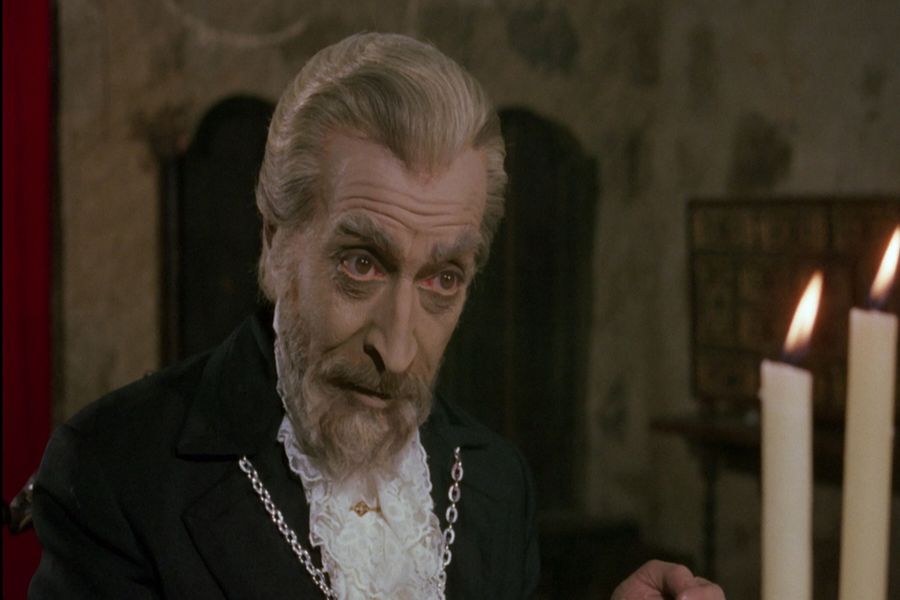
The picture dips in & out of the original Dracula story, adding inventive twists & turns. Our two leads work well enough- but really, it’s granddad Drac who is the best thing here, with his grey & slightly yellowed beard, deep blood-red pupils, and uneasy air.
There is some blood/ gore, as well as nudity- but the key is twofold: it’s a generally eerier, off-kilter air, which is added to by the generally flat English dubbing, and the whole thing with Dracs granddaughter/ what’s growing in her belly. There’s also an effective organ-based score that moves between jaunting/ wonk takes on Bach, to more abstract/ creepily roughshod fare.
On the extras side for this film, we have a commentary with Rod Barnett and Troy Guinn, Film Historians/Co-Hosts of NaschyCast. I’ve listened to a few tracks from these two, and once again it's a wonderful, well-researched and highly entertaining affair. They start by talking about how many of those involved in the film were connected with Spanish cult horror actor Paul Naschy, going from the director, cinematographer, and cast. They discuss the other three vampire films by director León Klimovsky, and how each looks at different facets of the Vampire, though the film has a very different/ odd tone compared to his other films. They talk about how the director utilised elements of Stoker’s original story, but took it to very different and surprising places. We find out that Klimovsky started his career as a dentist in his native Argentina, working for fifteen years in the job before getting into filmmaking. We find out he made a total of ten horror films in his career, though he always wanted to do arthouse, but never got the opportunity. We get lead cast bios, where we find out that the female lead Sáinz, was better known for her comedy and TV work. Later, they point out bit part/ characters actors as they appear. We get quotes from interviews with the actors regarding the director, finding out that he wanted them not to waste time on set. We find out that the crypts in the film were real, and at one point Sáinz fell asleep in the vampire coffins- scaring members of the crew for real- when she awoke. All in all, an excellent track.
Otherwise, we have: Klimovsky's Vampires (15.54) An Appreciation By Ángel Sala, Head Of Programming At The Sitges Film Festival. The Spanish Hammer: The Rise And Fall Of Profilmes (20.37) Interview With Profilmes Production And Sales Executive Lluís Ferrando. Inheritance As Horror: Blood, Tradition And The Gothic in The Dracula Saga (12.55) Video Essay By Kat Ellinger, Author Of Daughters Of Darkness. She begins by touching on the class element in the film and Vampire lore in general. She talks about how the film is unlike any other Vampire film, with the only one she sees connections with is Andy Milligan’s The Body Beneath. She discusses how the film also connects to Rosemary's Baby. Again, another worthy featurette from Ms Ellinger.
The final film here is The Turn Of The Screw (Otra Vuelta De Tuerca) from the year 1985. It’s a subtly homoerotic take on Henry James's 1898 classic Gothic novella of the same name. The picture is set around a huge manor house with nearby cliffs & ragged coastline, and is an effective mix of period drama, ghost-themed gothic, and are-they-mad-or-not psychological drama.
The film was the third-to-last film from Guipúscoa, Spain, born Eloy De La Iglesia director/ writer -who was known for his provocative films that figuratively stabbed at the Spanish regime, as it switched to democracy. In all, he directed twenty-two films, with these going from the fairy-tale anthology film Fantasía... 3 (1966), onto the claustrophobic romantic drama of lgo amargo en la boca(1969), serial killer exploitation meets slightly arty drama/ thriller The Cannibal Man(1972), early Spanish Giallo No One Heard the Scream (1973), brutal biker gang Sci-fi To Love, Perhaps To Die(1973), and a fair few films with- in the quinqui genre (delinquent crime films) like Navajeros (1981), and El Pico (1983).
The just over two-hour film opens with quite distinctive pre-credits, utilising paintings, line drawings, and a voice-over to illustrate the early life of the film's lead character, Roberto (Pedro Mari Sánchez), as he trained as a Jesuit priest as child/ young adult.
As we get into the film proper, we find out Roberto has dropped out, going home briefly to help his father on his farm, but fairly soon his dad's managed to get a job, looking after two orphaned siblings in a remote seaside mansion.
The sleeked-back haired & neatly dressed Roberto arrives at the mansion to be greeted by the most grateful Antonia(Queta Claver), the middle-aged housekeeper who has been largely trying to run the house on her own & look after pre-teen blond curly-haired / constantly holding a battered one-eyed doll Flora (Queta Claver).
As Roberto settles in, he finds out that Flora's older brother is away at boarding school- due back in a few months. The pair’s former governess and the place's former head of house have died in mysterious circumstances.
From the off, Flora seems a little strange- he first goes to meet her on the nearby autumnal beach, where a woman's voice keeps eerily calling her, but she says she can’t hear anything. Then, when a bath is run for Roberto, she wants to stay and wash him- he, of course, tells her to go.
As Roberto starts seeing both mysterious male/ female figures and hears creepy giggling. Then Mikel (Asier Hernández), Folra’s thirteen-year-old brother, is sent back from school because the other students are fearful of him. And we find out the governess and head of house were carrying out a kinky affair, pulling the two children into it too.
As you’d imagine, with this type of thing, the pace is slow and brooding, with some nerve-jangling moments of fear, eerie unease, and confusion about what’s real or not. Both the house and bleak beach settings are most effective.
All the small cast are excellent. To begin with, Sánchez, as the pair's carer/ teacher, seems self-assured/ pious, but he slowly but surely becomes more haunted. Claver and Hernández work well as the two children, shifting between low key weird/ creepy, to just kids trying to get over a troubling time.
There are a few moments of low-key homoerotism between the teen & Roberto, which felt rather wrong/ creepy, though the film never goes too deep down this cinematic road.
I’ve seen a few filmed versions of The Turn Of The Screw, and I must say this is a decent screen adaptation of the book, with quite a few original/ distinctive elements within the film. And I’d guess you’d say it’s the most formal Gothic film of this box set.
Extras-wise, for this final film we have a commentary track by Matt Rogerson, Author Of The Vatican Versus Horror Movies And Fulci’s Inferno: Faith In The Films Of A Horror And Giallo Auteur. He begins by discussing the pre-credits and how, reading between the lines, you can see that he left his faith due to his homosexuality. He discusses the Jesusita priesthood in general, and touches on how it is utilised in the first and second Exorcists. He discusses the change in the gender of the lead and its effect on the story. He talks about how both the house & beach are presented in the film. He touches on how the child actors are the perfect balance of innocence & unease. Later on, he comments on the attraction between the teacher and the boy in the picture. And we find out, via quotes from an interview with the director, that the lead actor was very vocal about not wanting to come across as homosexual in the role. It’s a decent enough track, with some worthy points & observations made.
Otherwise, we have Repression And Tragedy (13.12) An Appreciation By Ángel Sala, Head Of Programming At The Sitges Film Festival. One In Four Hundred (22.11) Interview with actor Asier Hernández. The Role Of My Dreams (20.39) Interview With Actress Cristina Goyanes. Head Full Of Phantoms (22.24) Video Essay By Xavier Aldana Reyes, Author Of Spanish Gothic: National Identity, Collaboration And Cultural Adaptation. He begins by discussing the director's shift between the gritty neo-realism of his Quinqui films and the Victorian Gothic ghost story of the film hand. We find out the film didn’t do well at its cinema release, and the little press it got was negative- not going to have either a VHS or a DVD release. He touches on the homoerotic elements in the film, and how the film plays with themes of gothic Catholicism. Again, a most worthy extra.
Danza Macabra Vol. Five: The Spanish Gothic Collection is another wonderful addition to this stellar and vital box set series. Once again, the Severin team have gone above and beyond to present each film in its best possible form, with the most informative and interesting extras. With this Vol., it was great to see them include films that use the gothic form in original/ creative manners. I’m very much looking forward to Vol Six!