
Children’s Film Foundation Bumper Box Vol 6 — Children’s Film Foundation Bumper Box Vol 6( DVD boxset)
Here from the BFI here is the 6th in their CFF bumper boxset series, which collects together British children's films from between the 50’s and the 80’s. All the films here were produced by The Children's Film Foundation (CFF)- a non-profit organisation that, between the late 1940s & 1980s, made one hundred and seventy-plus films, each running just under the hour mark. This three-DVD set brings together nine films & five shorts, and once again it’s an entertaining & fun set
First out of the gate on disc one, we have Mystery on Bird Island. This is from the year 1954 and has a rather Famous Five-type vibe.
It was directed/co-written by John Haggarty, who had only one directorial credit- this was Raiders of the River (1956), which on IMDb is classified as Sci-fi/ Crime, though it features a picture of two children, one playing a flute. He also has nine writing credits- these went from BBC series credits, as well as for the likes of French crime mystery Murder in Eden (1961), and Italian crime thriller The Killer Likes Candy (1968)
The fifty-seven-minute film was shot on the island of Alderney. It opens with two private school kids in their school uniforms getting off the boat with their parents- they’re brother and sister, short/scruffy-haired & rather bossy John (Vernon Morris), and his pig-tailed Marion (Mavis Sage)- the family have come to stay on the island for a week.
After dropping off their luggage/ donning shorts, John and Marion rush down to the nearby beach. Here, they encounter local children Jeanne (Jennifer Beech) & Victor (Nick Edmett)- who are the children of the island lighthouse keeper. Initially, John is rather nasty/ stand offish to the islanders.
A bit later on, when Jeanne & Victor are on a small offshore island/ bird sanctuary, they come across two men stealing bird eggs, but their boat drifts off…they hand signal John and Marion- with the pair coming to the rescue.
As the film unfolds, there is an on-foot chase across a rocky island with stolen eggs broken. There is a self-painted banner and a children’s marching band parade, a race to get a petition to the court, and baddies almost drowning.
All in all, a Mystery on Bird Island is a lot of romping/ Famous Five fun & adventure.
The second film on the first disc is 1956 One Wish Too Many, which is a mix of fantasy and comedy- focusing on a magical marble.
It was directed by John Durst. Between the early 50’s and late 60’s, he had ten director credits to his name- these went between shorts and features. Notable releases being world-shifting children’s fantasy The Secret Cave (1953) & short Song of London, which looked at the city's key tourist attractions in the year 1963.
The fifty-two black and white film opens with a panoramic camera shot of a rather smoggy/ hazed London, as a rather posh-voiced man talks about how you don’t expect much to happen on a winter's day in East London, especially something magical.
We then get introduced to our male lead, rather scruffy/ if well-meaning cockney schoolboy Peter (Anthony Richmond). He’s just got out of school, just avoids the local bully, and he’s making his way home walking through a very cold-looking street market. He stops to look at the toy stall with his neighbour/ platted-haired friend Nancy (Rosalind Gourgey)- he likes the look of the wind-up toy road roller, and she the dolly in a dress- but as neither has any money, they just shrug and move on.
Just by the side of the market, on the ground, Peter notices a marble- and fairly soon he realises it’s magical and will grant wishes to anyone who rubs it. First off, he wishes for two toys- both appear in his & Nancy’s hands, and as the film goes on, he does a bit of cluttered interior directing, cheats on maths homework, saves a geeky friend, etc. As you can imagine, things go too far, and he regrets having the marble. Both of our two youngster leads are very believable.
The other children cast are largely good- aside from the odd bit of flat acting. But we get some great/memorable adult characters like Nancy’s aunt Miss Mint (Gladys Young), who is a real busybody/battleaxe. And there’s Peter's strict/ stern/ moustached math teacher Mr. Pomfrett (Sam Costa)- both of whom get in a real pickle with Peter's wishes.
One Wish Too Many is most entertaining, and towards the end we get a great blend of comic chases & up in the air shenanigans- with Peter’s lorry driving dad coming to the rescue.
The third and final film on disc one is 1959’s The Cat Gang. This again brings to mind a famous five adventure, though they are only three kids, and it features some precarious/downright dangerous children climbing up and down a cliff face footage.
The film was directed by London-born Darrell Catling. Between the 1940’s and mid 1960’s, he had eleven credits- nine shorts, and one other feature, The Adventures of Dusty Bates (1947), which compiled together a lost serial regarding a boy pursuing jewel smugglers.
The film is set in a small coastal village. It brings together three lead child characters- brothers Bill (Jermey Bulloch) and John (John Pike)- the former is the older of the two with a thick mat of hair, and the latter is dark-haired, small, with a penchant for resolving issues with cars. And the older pre-teen with pig tails Sylvia (Francesca Annis), whose uncle E. Dodds (John Stacy) runs the local general store.
Bill & John decided they want to map where bird nests are located on the cliffs above the village- neither of them can draw, so they pull Sylvia in to draw the map, which starts getting more & more detailed with other things on it, as she draws up the maps, with the paper and crayon from her uncle's store.
The three start getting suspicious of the flat-capped, fast car-driving stranger who has turned up in the village, and when they have finally figured out what’s going on, they inform the local bearded customs office- with on land & on sea chases ensuing.
The Cat Gang is entertaining enough, with some neat/memorable touches- for example, E Dodds has several different hats, which he switches depending on where he is/ doing. And in a nicely tense moment, the kids manage to capture one of the baddies in a hatched basement, while his gang is trying to find him. However, the film does feel along similar lines to the first picture in the set Mystery on Bird Island.
We also get two shorts on this disc. Forest Pony! (22.01) from the 1940’s, this looks at the ponies of the New Forest- going from them being rounded up, trained/ broken in, etc. Five O'clock Finish (17.50) from 1954, this finds a bumbling mechanic played by Peter Butterworth trying to get his work for the day done ‘n’ dusted.
Moving on to disc two, and first out of the bag, we have Rockets in the Dunes from the year 1960. It’s set on the wide & long sandy beaches of Devon and regards a group of six kids who enjoy ‘sand yachting’- but unfortunately, the army starts training on the sands.
This was directed by London-born William C. Hammond. He had six other credits to his name- these include five features and a short. His other features were the likes of back-from-the-war romantic drama The Fool and the Princess (1949), family slapstick comedy The Flying Eye (1955), and The Carlingford School Mystery (1958), which sounds very Famous Five-like. Rockets in the Dunes was his final film.
The film is set in & around the North Devon coastal village of Croyde. And we kick off on the expansive beaches of the place, as we see thickly haired/ nearing teen Ned (James Luck) and friends racing across the sands on their wheeled yachts- but they nearly come a cropper, as there’s a huge army vehicle in their way.
The gang of six all head back to Ted’s parents' place for tea- a train carriage turned into a house on the dunes. And chat/ complain to mum- played by prolific character actress Hilary Mason (Don’t Look Now, Dolls, etc), and they're working on the local golf course, dad.
The gang decide something must be done, so they first approach local bird watching/ in a world of his own world doctor (Geoffrey Wearing) for help. They decide to rent the local hall this coming Saturday- but it’s a little pricey, so the gang think up things to raise money- like fishing for prawns to sell, making butter scotch, and giving sand yacht lessons.
We get a bit of danger/ trills from buried bombs on the dunes, there’s the always-forgetting-what-he’s-doing younger Joey (Christopher Witty), who has a puppy dog that always runs away, and a cool/ painted with groovy graffiti older brother back home to help.
Rockets in the Dunes is a charming & entertaining enough ride, with a passable enough cast, and of course, the sand yachts are very neat.
Next, we have 1966’s Davey Jones' Locker. It’s the first colour film in the collection, it’s set on the coast of Malta, and it features an early performance from a teenage Susan George (Straw Dogs, The Sorcerers, The Jigsaw Man). The films a mix of holiday drama and adventure- focusing on a group of young drivers.
It was directed by Nuneaton, Warwickshire-born Frederic Goode- between the early 60’s and late 80’s he had thirteen features to his name. These went from Egyptian family adventure Valley of the Kings (1964) mystery/ horror Beast of Morocco (1968), school trip to the Alps goes wrong adventure Avalanche (1980).
After the underwater credits, we meet our two leads- navy frogman Jim Matthews (Anthony Bate) and his son, teen Derek (Stephen Craig)- who are just surfacing after a dive. Coming towards them and narrowly missing them is a speed boat driven by the rather obnoxious/ constantly looking for trouble teen Spike (Michael Wennink), with his sister Susan (George).
The father and son get back to the shore, and into the hotel, stopping for a drink- but once again Spike is causing issues- first pushing Derek’s tanks in the way of waiter, then pouring milkshake over his head.
After a few more dives, a few of the holidaying kids ask Mr Matthews to teach them how to dive- he agrees but says to Derek that he must accept Spike if he wants to join up, and of course, he does.
Mr Mattews manages to collect together tanks for six or so kids in the class, naming it Davey Jones’ Locker. For the first half or so of the film, we get footage of the group training, all soundtrack by a blend of harp-edged easy listening and mellow jazz.
Then, you guessed it, Spike starts misbehaving/ not following instructions- putting his sister’s life on the line, and possibly the rest of the dive team.
It’s certainly interesting to see what tourism was like in Malta in the 60’s. The children’s actors are somewhat mixed. Craig is a light flat & clunky for our lead, Wennink as the not following the rules teen is good, as of course is George.
Davey Jones' Locker is fine- it’s just it takes time to get going/ starting to get the edge to its proceedings.
From 1968, Lionheart is another colour film, and I’d say it’s got the best-looking scan of all the films so far on the set. It regards eleven-year-old Andrew and his encounter with Simba the lion.
It was directed/ co-written by Wanganui, New Zealand-born Michael Forlong. Between the 1950’s and early 1980’s, he had a total of ten features to his name. They went from the WWII-set drama Suicide Mission (1954), onto the comedy Stork Talk (1962), through to family adventure comedy High Rise Donkey (1980).
The film opens at night, as we see the young blond-haired and pyjama-wearing Andrew (James Forlong) looking out of his bedroom into the garden. He can’t quite believe it, but he sees a lion wandering through the manicured beds of the garden- the animal looks at him, then pads into the nearby stable.
He rushes out and shuts the stable, then drops off to sleep. He awakes to find his upper-middle-class parents discussing that the lion has escaped from the local circus. Dad is saying that it’ll have to be shot- but of course is the last thing Andrew wants.
As the film unfolds, Andrew, his best friend down the road, and his older sister try to figure out what to do about the lion. We get a few familiar faces appearing here- there is Wilfrid Brambell (Steptoe & Son, A Hard Day's Night) as the Somerset accidented, hearing difficulties, and gummy-chucking family gardener Dingett. And Irene Handl (Metal Mickey, The Italian Job) as Lil Simba’s owner.
There is a group of soldiers sent out to track down the lion, including Joe Brown as the bumbling/ always getting things wrong Private Worms, who adds a few chuckles to the proceedings.
Forlong is good as our lead, who just wants to make sure the lion gets back to the circus unharmed. Both the children and the adult supporting cast do well. With the film being shot in a rural setting, with detached/ with land houses, and a small boys' school as locations.
Lionheart is thoroughly charming, and it brought back fond memories of my own childhood, as I grew up in a similar setting.
Once again, we get two shorts on here. The Magnificent Six and ½: Billy the Kid (16.40). This 1968 episode finds the gang finding a goat. The Chiffy Kid: Room To Let (18.27) This 1976 episode finds the gang befriending a homeless fiddle player and letting him stay in their club house.
Moving onto the third and final disc, we have 1975’s Smoky Joe's Revenge, which isn’t a vigilante cowboy adventure, its title might suggest. But instead, it regards three chums getting given a rundown tractor engine and doing it up, to enter the county show.
It was directed by Ronald Spencer, who was born in Billericay, Essex. He had eight credits to his name- these include the likes of Africa set family adventure Project Z (1968), tracking down cattle rustler’s family adventure The Copter Kids (1976), and documentary The Telephone Exchange (1982).
The film kicks off fairly manic- as we see runaway stream engine Smoky Joe-careering through the country roads. Behind the wheel is the moustached, florid-faced, and rather obnoxious Mr Williams (Robert Dorning)- the engine won’t break, and he ends up having to run it into a barn.
Looking on are friends- Debbie (Kay Humblestone), who is the youngest of the three, with curly hair and specs. Tom (Danny Martyne) and Jim (Nicky Cox) are chopper-bicycle riding pre-teens.Mr Williams has had it with Smoky Jo and wants to scrape him, as he’s just purchased a newer engine. So, he gives it to the kids.
Anyway, will the help of other locals, they fix its problems, and then do it up to enter the country show. The engine sometimes works on its own, and at times chats with Debbie.
There are some nice moments, physical comedy/ Mr Williams getting cross, and there are a few recognisable faces too- we have Gareth Thomas (Blake 7, Torchwood) as the friendly local police bobby. And John Barrett (The Eagle Has Landed, From The Madding Crowd) as an ageing steam engine enthusiast.
Smoky Joe's Revenge is another entertaining CCF film, and it was rather neat to see all the old engines at the county fair.
Next is 1979’s Black Island, which is a blend of thriller and adventure. It regards two thirteen-year-old boys stuck on an overgrown island, and they are not alone.
It was directed by Ben Bolt. He had forty-four credits to his name, taking TV shows/ films, and shorts.
The film kicks off with a minibus full of kids pulling up at the side of a field. The children are sent out to collect bugs/ small creatures by their teacher, with the best find getting 50 pence. Two of the boys, Michael (Martin Murphy) & Joe (Michael Salmon) decided to go beyond the forest they were told not to, and here they find a rowing boat- they decide to climb in. One thing leads to another, and they end up capsizing.
The boys both wash up on a small, isolated island- initially not aware that each has made it ashore, so we get some effective moments- as each makes the other jump.
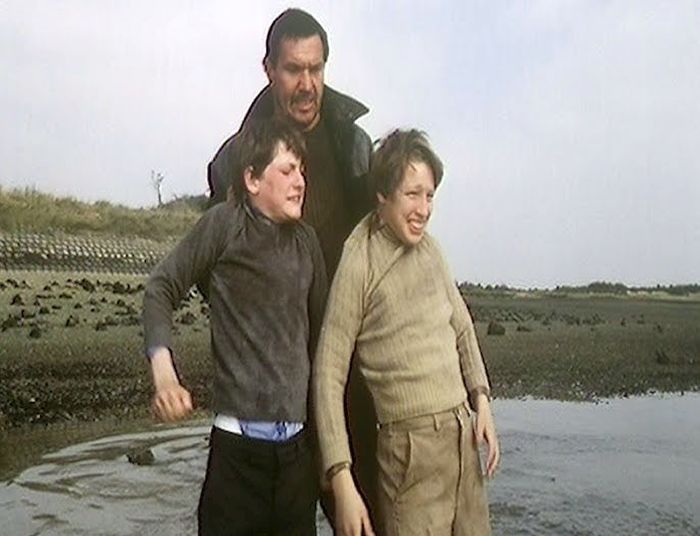
They build a fire, trying to get warm- but after leaving for a bit- they come back to find it’s been put out with water- so they are not alone, and we fairly soon meet them, with one of them being played wonderfully unpredictably/physically violent by Michael Elphick( Boon, Corky Park, Withnail and I).
Black Island has a rewarding twist ‘n’ turning mix of thriller & action, which I can imagine rather shook-up kids of the time, as there are some quite intense and intimidating moments in it.
The final film on the set is Danger on Dartmoor, which is from the year 1980. It’s, I guess, a mix of adventure & thriller, as three children get lost on the moor- with an escaped prisoner on the loose and a seemingly wild sheep killing dog.
It was directed by London-born David Eady. He had seventeen features to his name, along with the same number of shorts and TV show episodes. His features include racial-prejudice drama The Hearts Within (1957), Thriller/noir Faces In The Dark (1960), and invisibility-based family sci-fi/adventure Where’s Johnny? (1974).
The film opens at night, as pre-teen brothers Jonathan (Simon Henderson) and Robin (Marcus Evans) are trying to get sleep in their farmhouse home, but a wild dog is scratching at the door.
The next morning comes around, and we find out that not only is a wild dog on the loose, but it is being accused of being a sheep killer. A dangerous escaped prisoner is roaming the moor. The brothers are rather put out because their cousin from Birmingham is coming to stay, so they decided to scare her/ put nettles in her room.
Louise (Debby Salter), their thirteen-year-old cousin, finally gets to the farm- and she notices a strange older woman, played by Patricia Hayes, acting strangely around the farm. She follows her, but as the fog starts coming down, she gets lost.
The Boys realise she’s gone and go looking for her. As the film unfolds, we get a good selection of trials and tribulations- like getting stuck in a cave, the fog getting worse, hidden marshy ground, etc. This is, of course, added to by the threat of the prisoner & the dog.
Playing our escapee is Barry Foster (Frenzy, Van der Valk), and we also get an appearance of Michael Ripper, who, of course, is known best for his work on the Hammer Horror.
The three main young cast members are all good, with them acting believably in the suspenseful/dangerous. There are a few adult actors, but the prime focus is on the three children. Danger on Dartmoor is a good end to set, with decent pace & rewarding/ tense twists and turns in the plot.
Again, two more shorts on this disc. A CFF Production: Johnny on the Run (12.18), a new mini doc about one of the CFF’s early/ key titles. Our Magazine No 6( 10.30) from the 50’s( I’m guessing) featuring several shorts- like scouts making vehicles for a soap box derby, children going down a gold mine in Africa, children feeding trout, and a visit by two children to a festive garden & fun fair in Battersea.
Once again, Children’s Film Foundation Bumper Box Vol 6 is another splendid collection of CFF films, which are both entertaining and historically interesting. The type of films featured here are maybe not as varied as some of the releases in this series, but there are some real highlights here.