
Brute 1976 — Brute 1976 (VOD)
Despite its brutish and blunt name, this slasher directed by Marcel Walz is a stylishly photographed affair. As it opens emphatically on “August 19, 1976,” when we catch up with two young women trapped on a roadside who make the mistake of wandering down a mineshaft to an apparently sticky and flesh-ripping end….
The style, however, can’t make up for a horror that is disappointingly more derivative than reverential. Released in 2025, Brute 1976 adds to prolific filmmaker Walz’s packed horror filmography, which includes 2021’s Pretty Boy and 2025’s Garden of Eden. While the German director had previously remade Herschell Gordon Lewis’s early 60s splatter fest Blood Feast (as 2016’s Blood Feast), Brute 1976 finds him paying tribute to 1970s horror, particularly the rural flesh-repurposing scares of Texas Chainsaw Massacre and The Hills Have Eyes. But it’s a homage that can only go so far.
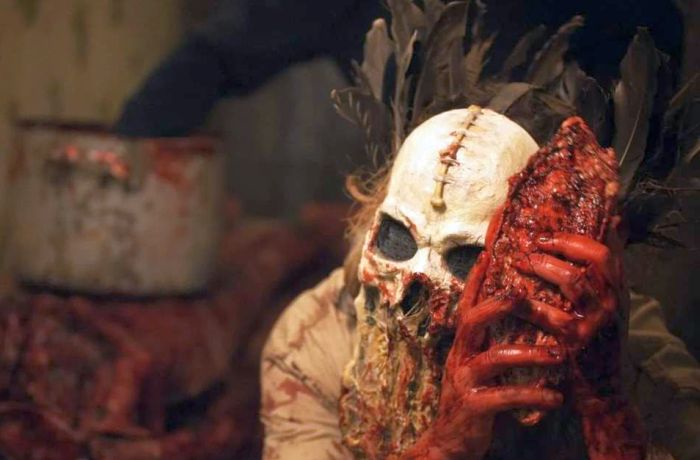
Brute 1976’s crisp, clear opening is backed by a heaving score, and features crazed axe carriers with bags over their heads, twisted ankles and a chainsaw-waving maniac in what looks like a flesh mask. It succeeds in setting out the film’s stall as homage to 1970s exploitation horrors, but also introduces some dodgy pacing that doesn’t improve as the main story moves on to a campervan of mismatched protagonists, who end up in the ominously titled town of Savage during a desert photoshoot.
Unfortunately, the quality of the cinematography is a barrier to mustering that 70s exploitation vibe. The framing often feels perfunctory, but the photography gives us a sharp image and swooping aerial shots that can’t match the grainy style of Brute 1976’s influences. Walz also doesn’t make much of an attempt to emulate the style of Tobe Hooper or Wes Craven, the directors of the films he’s evidently inspired by. There’s a forced stab at creating a loopy connection between action and vision, but scenes like the famous sunset sequence at the end of The Texas Chainsaw Massacre just aren’t there, leaving Brute 1976’s execution brutally exposed.
The structure also doesn’t help. For most of its runtime, Brute 1976 serves up victims and a family of predators in scenes with little connection until a ‘gathering’ scene at the end. There isn’t much of a sense of mystery as we’re prevented from growing close to either side during the stodgy line-up of deaths that pack out the second act (albeit one extended, gratuitous application of a drill that sticks out like a sore something).
At 107 minutes, Brute 1976 is a good 20 minutes longer than the original Texas Chainsaw Massacre, a runtime that really could have done with a well-applied chainsaw. That would have covered up some of the looser character turns and some starchy performances. Brute 1976 does attempt to bring purpose to its mayhem, with a double-twist and a deliberate attempt to link its massacre with social injustice, rooted in the 250th anniversary of the United States Declaration of Independence. That could sit well alongside the movie’s best scene—a montage to the Star-Spangled Banner that juxtaposes a desert photo shoot with billowing stars and stripes and a captive victim being taunted by entrails—but like the rest of the film, this doesn’t half go on.
Most distracting are the script’s laboured attempts to inject a post-modern, meta dimension. Some awkward scenes are stuffed with dialogue referencing The Texas Chainsaw Massacre and other influences (“They’re out there, in those hills, waiting”). Without some smart dialogue or quips to back it up, this sits uneasily; a knowing wink at an audience who may well not want to return it. It’s all a little one-note and overearnest.
With the promise of a follow-up in the form of the upcoming Brute 1986, Brute 1976 shows that heavy homage isn’t necessarily enough. With such a heavy draw on iconic 1970s horror that refuses to let go, it ends up feeling like a riff with nothing much to say.