
Black Rabbit, White Rabbit — Black Rabbit, White Rabbit ( Blu Ray)
Black Rabbit, White Rabbit is a 2025 Tajikistan/UAE production that blurs the lines between drama, mystery and dark comedy, with light touches of fantasy and playful surrealism. It regards three interwoven stories: a middle-aged prop master concerned about a gun, an aspiring actress trying to sneak on set. And a bandaged woman who was involved in a car crash, has a bossy/ unpredictable husband, and believes she has the power to move things with her mind. The film's a wonderfully intriguing/unpredictable/ at times mind-bending ride- all wrapped in a meta bow, so you're often unsure what is real & what is not. Here from Deaf Crocodile is a Region 1 Blu-ray release of the film, taking in a commentary track, visual essay, short films by the director, etc.
Black Rabbit, White Rabbit is directed/ co-written by Kermanshah, Iran-born Shahram Mokri. He has a total of nine films to his name, including four other features and five short films. His other features are non-linear drama Ashkan, the Charmed Ring and Other Stories (2008), a single-take arthouse take on the American slasher Fish & Chips (2013), futuristic noir meets existential puzzle of Invasion (2017), and the three distinct timelines setting of Careless Crime (2020), which was rife with temporal distortion and social commentary.
The film runs at two hours and nineteen minutes, which shifts between the three main storylines- the deeper you get in, the more unclear it gets what’s real & what’s not- so it’s a film you have to certainly give your all to, but it rewards in spades.
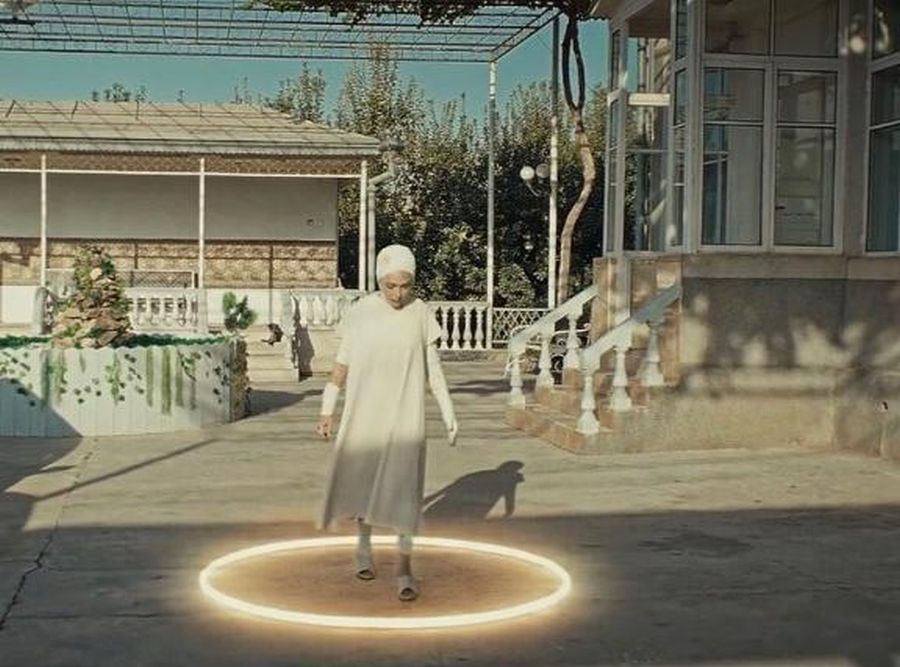
The first main storyline involves Sara (Hasti Mohammaï)- we first meet the bandaged woman wondering though her large, initially vacant house. In time, we find out the bandages are due to a car crash- where she drove off a cliff- and she is constantly berated by her husband for stinking.
There's Babak (Babak Karimi) a middle-aged film prop man, who we see on a shifting & busy backlot trying to locate a gun he has checked, before the film starts shooting. Linked into this we have the story of an inspiring actress who has sneaked onto the film's set.
The film features some wonderful following characters/ roaming camera work- there are often moments of both surprise & the surreal. For example, at one point a giant coffee cup is wandering around the backlot, and we see a wordless discussion between props.
Yes, Black Rabbit, White Rabbit uses very arthouse, time-warping, and meta elements- but it’s done so in both an engaging & intriguing manner. Yes, at points I had to rewind some scenes/ moments to fully understand what was going on- but in a way that made an even more rewarding ride/ puzzle of a film.
On the extras side, we get a few new things- first of these is a commentary track with film programmer and critic Tori Potenza. She goes from talking about how the film is a rather unexpected mystery that’s beautifully crafted- and how you can see the step in budget from Mokri earlier films. She touches on how all of his films are very different, with the film to hand having its own tone and feel. We get quotes from the director, talking about how he treats filming as if it were a theatre production, and instead of storyboarding scenes, they make a 3d model of each location. She discusses the set dressing of Sara ‘s house- point out the pictures of a waterfall, butterflies, and weaponry. Later on, she talks about the influence of Dutch artist M. C. Escher on Mokri films, discussing some of his key works like Relativity- with its gravity and architectural structure of several staircases. Touches on certainly charictor tropes and more- all in all, it’s worth a play track, though she does run out of things to say later on-though it must have been difficult to keep going over two hours and nineteen minutes.
The other new extra here is: The Maze: Entrances and Exits in Black Rabbit, White Rabbit (12.58) , which is a visual essay by filmmaker and scholar Stephen Broomer. He talks about how the film is a maze in both form and narrative, and that everything has its shadow. He discusses the use of rabbits in the film/ their meaning. The use of doubling and more. This was interesting enough, though at times it does sound like an academic lesson.
We get a selection of early short films from Mokri: 'The Dragonfly Storm' (Toofan-e Sanjaghak) (2002, 15 min.); 'Limits of the Circle' (Mahdoodeh-ye Dayereh) (2005, 15 min.); 'Ando-C' (2007, 15 min.)
Put simply and straight, I was blown away by Black Rabbit, White Rabbit. It was such a wonderfully crafted and thought-out jewel of a film, which kept me both constantly intrigued and rewardingly puzzled. Mokri truly has such a talent for using arthouse and surreal tropes in a rewarding yet approachable manner. A truly unmissable film!. As long-term readers of m[m] know, I rarely give out straight 5 out 5, but this more than deserves it.