
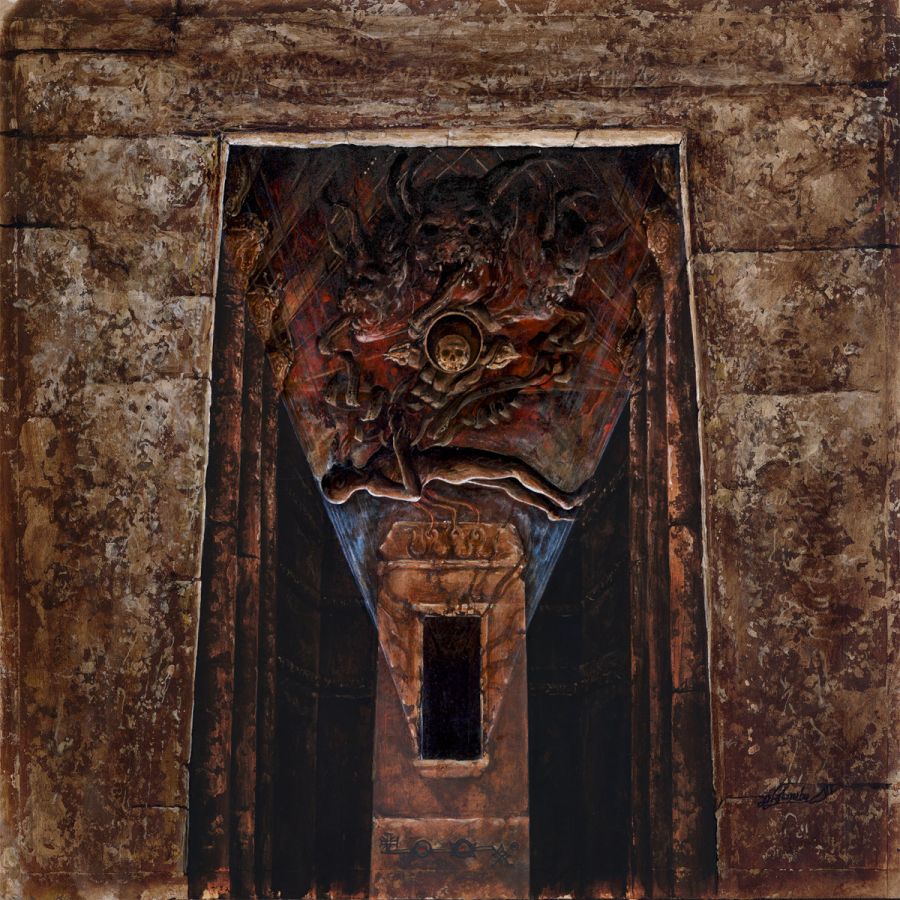
Ain Sof Aur — Theos-Vel-Samae
Ain Sof Aur is a Brazilian post-black metal/funeral doom band which has existed since 2006 but has only released a few albums, with long gaps between. Theos-Vel-Samael, their first since 2018, features three lengthy songs, the first of which is over 20 minutes. Beginning with slow, cinematic post-metal progressions, we quickly move into blastbeat territory, showing the band's wide range.
For the majority of the long tracks, the pacing thins back out, with mid-paced palm-muted chugs and sustained dissonant chords in a sort of droning, hypnotic repetition, which leads me to funeral doom comparisons. This album has many commonalities with the group that is by far my favourite of the funeral doom genre, Esoteric, going beyond the Sabbath-esque pentatonics and power chords of traditional doom into something more open-ended and uneasy, with heavy use of extremely dissonant progressions, an occasional haunted melody, and an almost symphonic scope. Like Esoteric, this band can be fast when they choose, but this is not their natural mode. The blatant striking of tritones and the intentional avoidance of anything conventionally harmonious also reminds me of avant black metal bands like Deathspell Omega (who similarly created an album with three lengthy, untitled tracks in Kenose). The riffs, in their discordance, are not catchy, rather they are like apparitions which seem to evade the memory. Often, half of a more standard minor key melody occurs before being intentionally disrupted with the most dissonant possible note choice.
The vocals take a lot of influence from classic black metal, complete with maniacal evil laughing. There are theatrics I might compare to Darkthrone's Nocturno Culto or Dimmu Borgir's Shagrath, but with a deeper, lower tone that is more akin to death metal. These vocals certainly do a lot to make the album cheesier, more trivial feeling, with campy lyrics about Lucifer, or phrases like "Darkness comes for the accursed ones, ahahahah!". Most of the lyrics, though, are thankfully inaudible, and the singer's lower range growl has a solid and powerful tone to it, with good breath support, and there are a good many satisfyingly heavy moments.
The album is a pleasant succession of chunky riffs, but doesn't quite seem to tie the longer pieces together with any particular theme or momentum. Without clear callbacks to previous sections or ideas, at many points, it feels like a song ends and another starts, all within the same longer track. There is a sort of ghoulish emotional detachment to most of the music, which isn't necessarily a bad thing considering the band's black and death metal influences and chosen dark aesthetics, but it seems to run counter to the idea of larger emotional narratives within the long pieces. Most isolated moments within the pieces, whether towards the beginning or end, feel dissociated, outside of time... as opposed to engaged in any kind of gradual build-up. The most dramatic climax of the album, ironically, is part of the shortest track, the nine-minute closer "III", which also has the best dark, melancholic lead melody of the album.
The most impressive element is likely the drummer, who has a very active playing style, with many accents and fills even at slower tempos, and a penchant for sustained kick drum rolls that are impressively even, yet retain a sense that the playing is live and organic, rather than sequenced or produced. A lot of the album's groove comes from this performance.
Whether this album is a success may depend on taste; rather than an emotional or dramatic progression over the course of a 10-20 minute song, you get detached emissions from an abyssal hellworld, the raspy soliloquys of a re-animated skeleton. It is not the most unusual or creative writing I have heard in a long-form post-black metal project like this. Still, it is certainly satisfyingly heavy and rhythmic, in its sluggish mid-paced way, with a stubborn insistence on discordance. An enjoyable metal release.