
I Have Always Been Here Before
The Hauntological Film
“Cinema plus psychoanalysis equals the science of ghosts.”—Jacques Derrida
Although the field of hauntology emerged from philosophy, the social sciences, and literary criticism, its progenitor, critical theorist Jacque Derrida, seemed most comfortable using cinema to explain and broaden the ontological and epistemological boundaries of his concept. For Derrida, movie-making was not only an aesthetic experience but also a shared exorcism, a synergetic séance, “the art of allowing ghosts to come back.”
Derrida’s used hauntings, ghosts, and revenants as metaphors representing individual and collective guilt and responsibility in the late twentieth century, a shared feeling of fear, awe, sorrow, and anticipation when faced with millenarian hopes and forebodings for the future. The end of the twentieth century was the spectral moment: a juncture that no longer belongs to linear time, secretive and untimely, outside of scientific progress and accepted, official history. Ghosts represent the politics of memory, of inheritance, and of expectation. More importantly, hauntings are discordant and jarring to the living; ghosts problematize and disrupt our perceptions of time, space, and what it means to be human.
Derrida saw that, whether one believes in ghosts or not, ghosts have to be lived with; they can’t be easily expelled from our lives. The shock and disruption of hauntings, of the return of people, historical occurrences, memories, beliefs, artistic forms, and emotions force us, individually and collectively, to recognize instances of broken time: what is no longer and forever not yet. The past is never really past; the future never arrives: the present is always here.
For Derrida, haunting represents an obsession, a trauma, a fixed idea, a nagging, persistent memory that will not go away. Hauntology attempts to make these memories material, to allow them to speak, to transform them into a desire for a better, more just, life as part of the future that the victims of the initial trauma did not see as being possible. In this way, hauntology articulates a longing for the disappeared or never happened.
Unsettling, vanished pasts and lost, cancelled, anachronistic futures are preserved in hauntological works, works that explore the dialectic between yesterday and tomorrow using notions of memory, nostalgia, trauma, ghosts, hauntings, the supernatural, technology, media, time, in-between states of existence, and presence. Hauntological works critique the illusion of linear progress, question the evolution towards a better future, a better humanity, a better tomorrow, offering alternate timelines and outsider perspectives of how histories unfold. In many of these works, there is a nagging sensation of repetition, of endless cycles constraining and imprisoning us, trapped by our own nostalgic clinging to a belief in past wholeness, simplicity, and purity. Hauntological works focus on the fragmentary, the broken, the degraded, the discarded; aesthetics, political solutions, social institutions, technologies, and cultural forms that have been rejected, erased, silenced, forgotten, and pushed to the margins. Hauntology encompasses the lost, forgotten, obscure, clandestine, useless, abandoned, rejected, and failed; the has-beens that never were.
As noted by Derrida, the perfect genre for hauntological works would appear to be film, with its ability to edit and create jumps in time, space, and continuity, not bound by linear narratives or perspectives. Movies are also nostalgic talismans that reverberate in the hearts and minds of viewers, whether they are cineastes or not. Cinema has a habit of consistently recycling, remaking, and rebooting whether audiences want the return or not. Although there have been plenty of ghost movies, the hauntological film is harder to identify because of its often recursive, disquieting, and enigmatic nature; just because a film has a ghost in it doesn’t necessarily mean it is hauntological. (Some hauntological films don’t even have traditional ghosts in them.) Ghosts and hauntings need to be metaphoric and indefinite, not just fodder for jump scares; specters in hauntological films can be both literal and figurative representations of personal and collective traumas. These hauntings must remain ambiguous, problematizing notions of past, present, and future, taking the forms of memories, longings, and obsessions that are conjured, fetishized, and exorcized through personal, historical, spatial, and temporal dislocations and experiences.
Over the last twenty years, an informal canon of hauntological cinema has been established, identifying films such as The Shining, Blade Runner, Daughters of the Dust, Don’t Look Now, Solaris, Mirror, and The Last Wave as exemplars of this loose “genre.” Here are a few more candidates to be included in this spectral style of movies:
Vertigo (1958)
Alfred Hitchcock’s masterpiece (based on Boileau-Narcejac’s 1954 novel D'entre les Morts) begins with a film noir plot of deception and treachery but then evolves into a profoundly morbid treatise on how an obsession with the past can destroy any attempt at moving beyond trauma into the future. As reflected in its title, Vertigo uses the image of the circle and its inescapable sense of repetition, futility, and closure to suggest how a fixation on an ideal chimera, a self-created phantom, and an implacable memory will ultimately destroy all who are caught up in its vortex. Police detective Scottie Ferguson’s infatuation with a ghostly woman who doesn’t exist except in his traumatised mind haunts him until he tries to recreate the past and rebuild his untouchable fantasy as the hero becomes the villain, the victim becomes the perpetrator, and the living become the dead. Possessing a ghost is as ridiculous as possessing a reminiscence, especially when both are fabrications. Scottie is the epitome of Thanatos, in love with a revenant, driven by a death wish that will lead to not only ruination, but also the repetition of the very shock that created his self-perpetuating anguish. This notion of reincarnation, of being trapped in a circular fate, living a life over and over again with the end already decided is portrayed in a remarkable sequence in a redwood forest as Scottie and his doomed object of desire look over the epochal rings of a giant sequoia tree, identifying in its circles when a shattered woman lived and died, her pain returning to be endured again and again on her haunted proxies. After pronouncing her own death sentence, the apparitional Madeleine seems to dissipate into the shadows of the silent towering woods, lost to time and space, but always compelled to return.
Night of Dark Shadows (1971)
The second film based on the mythos of Gothic soap opera Dark Shadows, Night of Dark Shadows moves away from the vampire-centric focus of House of Dark Shadows (1970), showcasing a story that is haunted by ancestral inheritance, guilt, obsession, and the intrusion of a past that won’t let go of the present. Quentin Collins inherits his familial estate Collinwood but also acquires the ghost of the witch Angelique, hung for not only delving into the black arts but also for her adulterous, defiant affair with brother-in-law, Charles Collins. Collinwood’s present master becomes the target of Angelique’s amorous compulsion as Quentin is possessed by his ancestor Charles, repeating the past as his marriage and mental health are destroyed by this intrusion from the early 19th century. Quentin’s birthright is inescapable: he shares a soul with his brooding estate and with Angelique’s lustful demands; the wraith’s revenge for the Collins family’s punishment of an independent woman struck down by the family’s patriarchal control. Inheritance is not only material; it is a felt burden of history and time that crushes the present world of the inheritor at Collinwood. The curse of the Collins brood is one of repetition and anguish as its descendants are bound to reenact the wrongdoing and trauma that have stained the family line: the sins of the fathers are visited on their sons forever. Angelique’s obsession with the Collins’ pedigree transcends linear time and progress: an unfulfilled love that drains and annihilates its generational victims which causes the spectral Angelique (often portrayed in bilious white dresses and beckoning hands) to seek out another victim, which will only keep the cycle of predation going on ad infinitum. Not even death can end Angelique’s need for vengeful, lustfully romantic parasitism. The denizens of Collinwood can’t escape the past because they are reliving it through reincarnation and recurrence; their fates have already been decided, condemned to play roles written for them by ancestral legacy and family tragedy.
Requiem for a Village (1975)
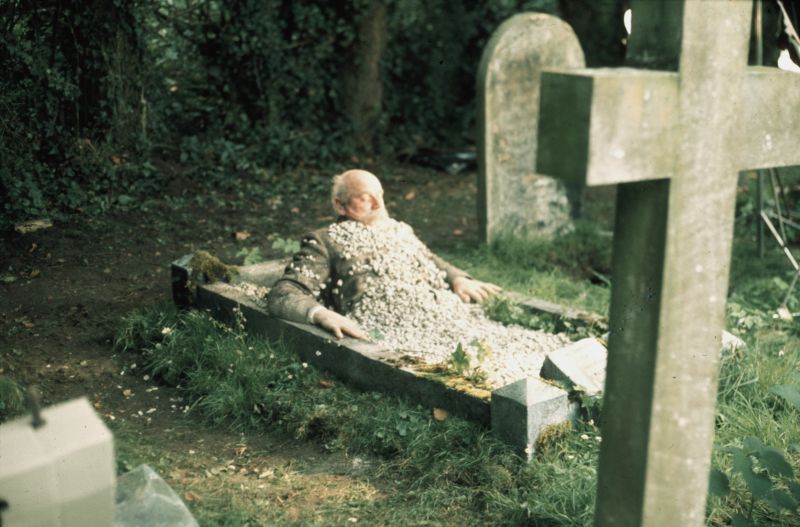
David Gladwell's docu-elegy for an English rural community is a hauntological commemoration of a way of life that is slowly fading into obscurity in the face of modernisation and the death of tradition. The village of Witnesham lies on the cusp of two ages: an outmoded folk-pastoral agrarian community and a mechanised, technological market-driven contemporary society. As one way of life erases the other, Gladwell’s film focuses on the disappearance of a deep-rooted culture and its transformation into a ghostly relic that will only live in vanishing memories and eroding architecture. These revenants are materialised in obsolete forms of work, crumbling buildings, antiquated customs, and a generation of people who seem to have outlived their usefulness in the modern world. Requiem for a Village offers no nostalgia for a “golden age” of country life, which is shown to have had its own hardships, struggles, and disparities, but rather questions what becomes of those who are lost, forgotten, and anachronistic. These feelings of being made economically, socially, and existentially “redundant” are portrayed through the juxtaposition of historical and contemporary images that overlap, producing the idea that the village contains multiple layers of time simultaneously, haunted by everything and everyone that ever existed there. This notion is vividly portrayed in a sequence where corpses emerge from their graves in a decrepit cemetery, as if the dead demand to be remembered and kept alive as the community leaves its traditions behind. Gladwell sees a bleak future for Witnesham as the children of the village will have to leave their homes to find some kind of survival in an alienated, contemporary landscape that only values the new, the efficient, the profitable, and the now. The coming depopulation of the village will forever change the relationship between its inhabitants and the cycles of the land, with the only remaining villagers becoming living ghosts, left behind, possibly never to return, except in the shadows of degenerating minds and deteriorating edifices.
San Soleil (1983)
Director Chris Marker already has one hauntological masterwork, La Jetee (1962), to his credit, and so his experimental film-essay-travelogue San Soleil is further proof that he deserves to be included in the hauntological film Hall of Fame. Utilising a wandering collage of thoughts, images, correspondence, and scenes borrowed from other works, San Soleil is a meditation on the nature of human memory and its struggle against time, asking the Proustian question can we ever transcend the passage of perpetuity? For Marker, the effects of time on humanity are inevitable; there is no escape. Memory, film, and ghosts will eventually fragment, dissipate and disappear. The film visits Cape Verde, Iceland, Paris, Tokyo, and San Francisco displaying both the modern and the ancient, the East and the West, dreams and materiality, the technological and the mystical, and suggests that all these cultures, belief systems, sensations, and achievements are essentially ghostly and will eventually fade away no matter how hard we try to preserve, record, and catalogue them. By piecing the film together from so many disparate elements, San Soleil attempts to replicate the fragmentary experience of memory and perception, a collection of impressions, perspectives, and moments externalized in an attempt to defeat forgetting and obsolescence. Marker admits that this is a fool’s errand; just as the human mind will eventually deteriorate and disappear so will all our attempts to preserve the past, whether they be in letters, photographs, video, or cinema. San Soleil is a ghost, a memory, an absurd cry in the face of the inevitability of dissipation. Nothing lasts, but perhaps this is what makes memories so priceless because they are fleeting and ethereal, like tears in rain.
Beloved (1998)
Jonathan Demme’s extraordinary adaptation of Toni Morrison's 1987’s superlative novel Beloved portrays both literal and figurative ghosts as symbols of individual and historical traumas and the inability of a people (and, by extension, a nation) to move on from the past without acknowledging the horrors that were perpetrated and endured. In the Reconstruction-Era American South, former slave Sethe is haunted by uncanny phenomena, a poltergeist, and by the phantasmic Beloved, the reincarnation of the daughter she killed rather than let be enslaved. The regret, anger, misery, and pain suffered by Sethe reflects the continuing legacy of slavery even after the end of the Civil War, as well as Serthe’s attempts to forget the atrocities she suffered under her brutal subjugation. Although the physical bonds have been broken, the insidious institution continues to terrorize and torment the psyches of its victims. Specters still remain long after “freedom” is granted with the emotional and spiritual effects of physical abuse, sexual violence, family separation, and racial oppression possessing all the film’s characters. (The cast of the film immersed themselves in intense physical, emotional, and psychological preparations in order to portray the hellish, agonising realities of slavery and racial trauma.) Devastating memories inhabit Sethe’s mind like ghosts locked up in a haunted house, materializing as physical forces demanding recognition and reckoning that the protagonist represses out of fear and guilt, resulting in the materialisation of Beloved. The character of Beloved is the persistence of both personal and antebellum ordeals experienced by Sethe and African Americans, a portentous legacy that cannot be exorcised until remembrance, truth, and healing are accepted as the means for historical justice.
Arcadia (2017)
A precursor to the UK “re-enchantment” movement started in the 2020’s, Paul Wright's Arcadia can be seen as an unofficial sequel to and an updated extension of the themes of Requiem for a Village, An experimental documentary exploring Britain’s relationship to its own geography, Arcadia is a patchwork of images drawn from more than a century of archival footage (ghosts caught on film?) tracing the impact of modernisation, industrialisation, social change, and capitalism on the conceptions, perceptions, and lived experiences of Albion. The film seems most concerned with the decimation and transformation of British rural tradition as the spectral, antique impressions of farms, festivals, dancing children, and pastoral lands are overtaken by the brutal depictions of the mechanisation of labor, factories, urbanisation, and environmental disaster. Like Gladwell’s film, the central concept of Arcadia is not the nostalgic value of these anachronistic chronicles, but rather what they say about the breakdown of the vital connections between people and their disappearing landscapes. It is not only the physical and emotional ties to nature that are being wiped away, but the spiritual and mythic ones that are fading into nothingness. Wright includes imagery drawn from England’s pagan past such as folk rituals, holiday customs, magic lore, and occult symbolism to portray the cultural and metaphysical value of keeping the “old, weird Britian” alive for future generations. This alternate history is not dead but merely sleeping, haunting the collective psyche of England, leaking out in bits and pieces contemporized in punk rock shows, raves, football chants, and carnivals. A recognition and celebration of communal folk life is the way to combat consumer individualism, ecological exploitation, and technological isolationism through rejection of the commodification of land and heritage. Globalization’s attack on the countryside, the past, and its severing of the deep resonance of landscape and folklore with its inhabitants are the key traumas that are creating the ghosts that haunt capitalist notions of property, real estate, “development” and speculation. This disruption of the material and mystical cycles of both nature and life needs to be addressed if there is any future for the dislocated, lost, rudderless people of England.
Enys Men (2022)
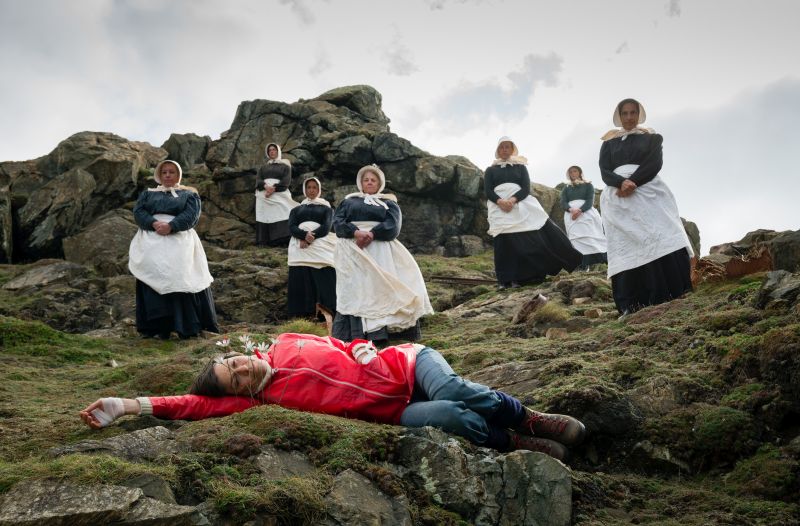
The films of Mark Jenkin have effectively brought landscape and cultural geography to the hauntological film. Focusing on the topography and the people of Cornwall, Jenkin’s works intertwine memory, recurrence, separation, and the perseverance of the past. His film Enys Men is the apotheosis of this synchronous overlaying of the past and present, of official and folk histories, in the form of residual hauntings that resonate by how the living imprint themselves on the natural features of the earth itself. A scientist studying the flora of an isolated island begins to experience time slippage as spectral images, people, and occurrences phase in and out of temporal zones with antiquities, memories, hallucinations, and ghostly manifestations occurring simultaneously. The island is inhabited by revenants stuck in the rocky terrain: miners, soldiers, children, religious figures, the dead, and earlier versions of the protagonist herself emerge from the mines, ruins, megaliths, cliffs, and the sea as traumatised repositories of bygone days. History is not an abstract measurement of time but rather a material, lived interaction between the people and the land. The film’s rhythms reflect the concept of cyclical time and eternal recurrences as the same characters, gestures, images, sounds, and situations keep returning in slightly altered forms as if time doesn’t progress; chronology is just a repeated series of echoed superimpositions in different guises. The eerie anachronisms and desolate environment create a phantasmagoric atmosphere of haunted time and repetitive visions of concurrent lives existing alongside and in between each other. In the end, Enys Men suggests that we are all ghosts shackled to our settings by our repressed remembrances, scarred by personal and historical tribulations.
By William Burns
For more information on hauntology and its relationship with literature, television, cinema, and music, check out Ghost of an Idea: Hauntology, Folk Horror, and the Spectrre of Nostalgia published by Headpress Books
Stills used for Requiem for a Village and Enys Men with kind permission from the BFI.
Here’s a direct link to purchase Requiem for a Village, and here for Enys Men